
The pipeline, counted
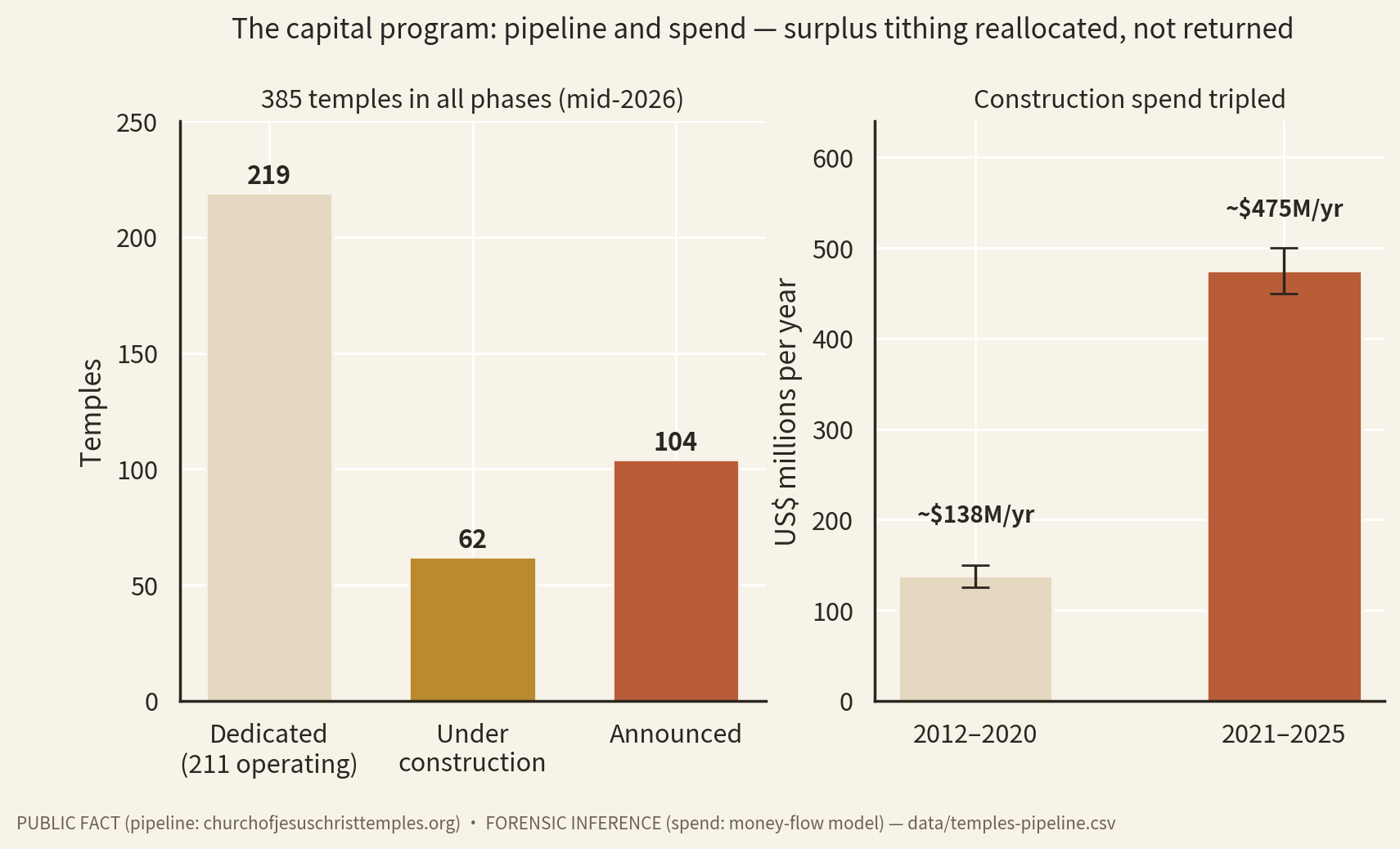
As of mid-2026, the maintained public chronology records 385 temples: 219 dedicated (211 operating, 8 closed for major renovation), ~62 under construction, and ~104 announced. The presidency that began in 2018 has announced roughly two hundred of them — more temples announced in seven years than existed in the institution’s first century and a half.
The construction account shows what that announcement wave means in money:
| Period | Annual construction spend (all buildings) | Note |
|---|---|---|
| 2012–2020 | ~$125–150 M/yr | Temple building steady; chapel construction ongoing |
| 2021–2025 | ~$450–500 M/yr | Temple surge; net chapel construction ≈ 0 |
Both figures are forensic inference from the money-flow model. Two mechanics sit beneath the surge. First, ~1,100 chapels were removed from use and sold between 2019 and 2022 — consolidation from the two-hour meeting schedule — so chapel construction now nets to roughly zero: the building budget is increasingly a temple budget. Second, dedications are running at 12–20 a year against a pipeline of ~166 (62 rising + 104 announced), implying 8–14 years of construction already committed before any new announcement.
Unit economics
The dimensions database puts recent standard-design small temples at roughly 10,000–30,000 square feet; the legacy flagships run 100,000–280,000 (Salt Lake: ~253,000). At the documented completion rate and spend, the blended cost of the current wave is on the order of $20–25 M per completion — with small standard temples well below that average and large urban temples at multiples of it. The Office publishes these as model ranges, not measurements: the institution does not disclose temple costs, and journalism has extracted only scattered points.
Committed-pipeline arithmetic, stated as the rough model it is: ~166 temples in the pipeline × a blended ~$20–25 M ≈ $3.5–4 B of construction already announced. That is the capital program’s visible principal.
The obligation outruns the construction
A temple is not a one-time expense. Each dedicated temple carries staffing, utilities, maintenance, and periodic major renovation (8 of the 219 are closed for exactly that now). The Widow’s Mite model’s long-run finding deserves its plain statement: the operating obligation of the temple estate compounds with every dedication, and it never retires. On the model’s assumptions, annual temple operations already run to hundreds of millions of dollars, and the current wave — concentrated in smaller markets — adds temples whose local attendance bases are the thinnest in the system.
The 1,000-temple scenario, which the Widow’s Mite report first quantified and the Office reproduces with attribution: at the announcement rate of 2018–2025, four figures is not rhetoric but arithmetic; the scenario’s point is not the count but the slope — an estate whose fixed operating cost eventually commits the entire operating account, whatever the reserve holds.
What the program displaced
This is the finding that connects the building account to the rest of the ledger. Before 2022, roughly $1–1.3 B/yr of surplus tithing flowed into the reserve each year; the 2013 internal slide quoted in litigation described “approximately $1bn granted to EPA on an annual basis.” By 2025 that flow had fallen to roughly zero (Statement of Flows). The reallocation went substantially to two places: the humanitarian increase (~5×, 2021–2023) and the temple surge — a tripling of construction spend.
The Office records the sequence without decorating it: for a quarter-century the surplus was saved; after the December 2019 disclosure made the saving visible, the surplus was spent — on buildings members can see and aid the world can see. Both uses are more defensible than the hoard. Neither is a distribution from the hoard. The reserve itself remains untouched; the program is funded from current income, and the reserve’s ~$25 B/yr of investment profits continue to compound (Humanitarian Ledger, §6).
Temples per member — the quiet ratio
Year-end 2025 statistics report 17,887,212 members and 32,046 wards and branches. Against the Office’s active-membership envelope (3.8–5.4 M — see How Many Saints?), the 385-temple program works out to roughly one temple per 10,000–14,000 active members, against one per ~30,000 at the century’s turn. The ratio is offered without a verdict: the institution reads the program as prophecy accelerating; the ledger reads it as fixed-cost expansion into a market whose activity indicators are declining (Active Membership). Both readings fit the same numbers. The numbers are what this page exists to fix.
What this account cannot see
- Temple costs are not disclosed; every cost figure here is a model with a stated basis, not a measurement.
- The split of the construction budget between temples and other buildings is estimated, not reported.
- Announced temples are not obligations; some announced temples are never built. The pipeline figure is the planning record, not a commitment schedule.
- Whether the surge is timed to the disclosure is not knowable. The sequence is documented; the motive is not.
Dataset: data/temples-pipeline.csv. This part is re-issued annually against the maintained chronology; corrections appear in the log.
One click copies the complete, sourced text. Paste it into Claude, Kimi, ChatGPT, or any AI session and ask your questions there. Even our longest document fits in one paste.
Sources
- churchofjesuschristtemples.org — maintained chronology, status, and dimensions databases (counts current as of mid-2026: 219 dedicated, ~62 under construction, ~104 announced; 385 total); PUBLIC FACT as to the pipeline.
- The Church of Jesus Christ of Latter-day Saints, year-end 2025 statistics (membership 17,887,212; wards and branches 32,046).
- Widow's Mite Report, Temples (2022) and Tracking LDS Temple Data (updated 12/31/2024) — unit-cost and construction-spend models; marked forensic inference; construction-spend figures transcribed in the Office's money-flow dataset.
- Wall Street Journal, 2023 — reporting on the global building campaign and temple costs; PUBLIC FACT as to the existence of the reporting.
- Office dataset: data/temples-pipeline.csv (published with this part).