
Definitions first — three different things share one name
The institution’s annual “caring” total bundles three flows that this ledger separates:
- Humanitarian aid — cash and goods given without regard to faith, race, or nationality: disaster relief, water projects, immunization, maternal care, the World Food Programme partnership.
- Welfare and fast-offering assistance — aid directed primarily to members: bishops’ storehouse orders, rent and utility assistance, Deseret Industries, employment and self-reliance services.
- Imputed value — the dollar value assigned to member volunteer hours (6.6 million in 2024) and to in-kind commodities produced on welfare farms and in bishops’ storehouses.
All three are real. Only the first is what a lay reader means by “humanitarian giving,” and only the first is comparable to what a foundation or an aid agency reports. The ledger keeps them apart because the institution’s headline does not.
The documented timeline
1985–1996 — the founding. The humanitarian arm descends from the 1985 special fasts for Ethiopian famine relief — members gave, and the money left the institution. LDS Charities was formally organized in 1996, the same year the donation slip acquired a “Humanitarian Aid” line. The Office records this because it establishes the pattern the ledger measures: the impulse to distribute is genuine, member-carried, and older than the hoard.
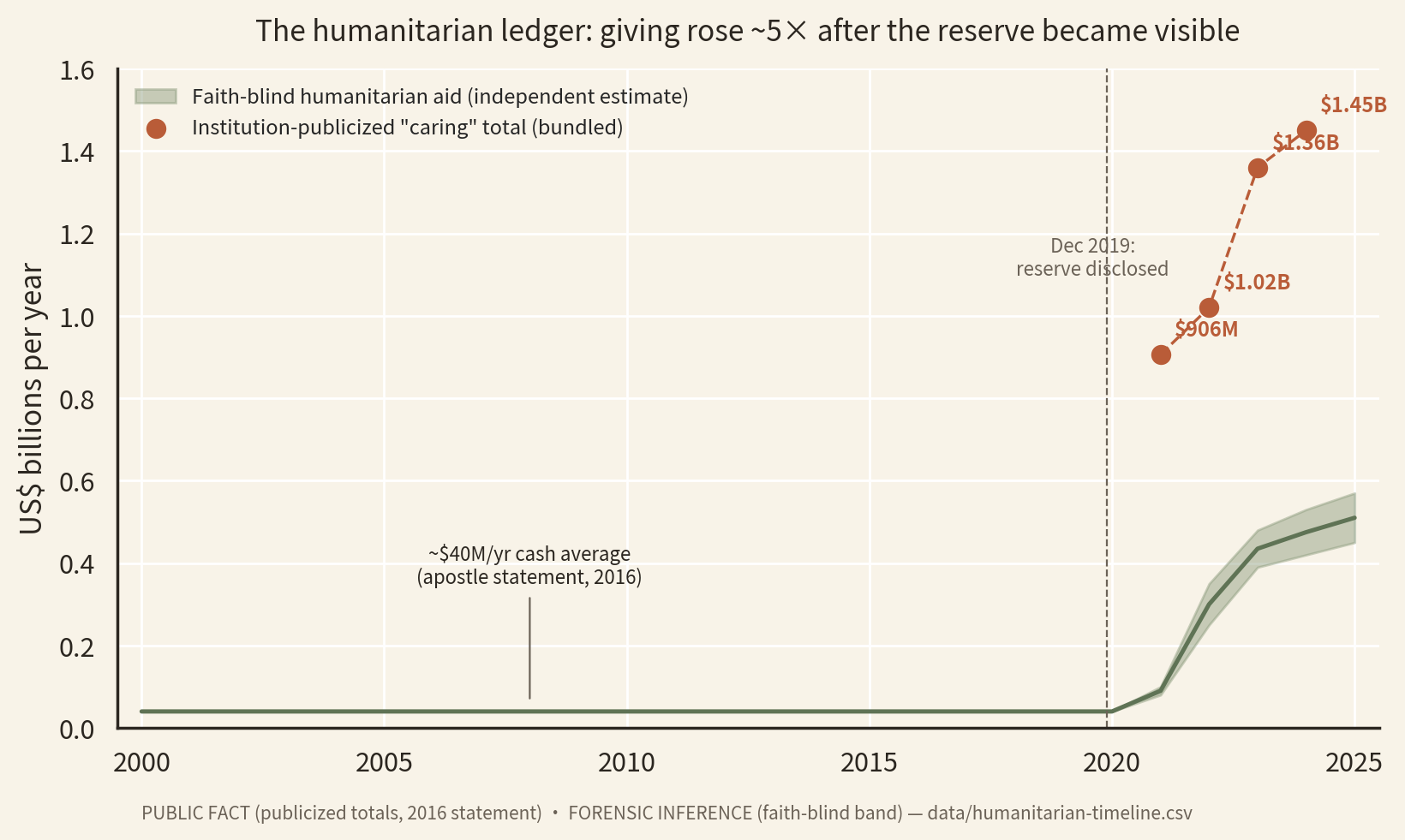
To 2016 — forty million a year. In 2016 an apostle stated publicly that the cash portion of humanitarian aid had averaged ~$40 million per year in the years to that point. Read against the visible reserve of those years — Account A passed $10 B in 2005 and $30 B by 2017 — humanitarian cash giving ran between roughly one- and four-tenths of one percent of it, shrinking as the reserve grew: the fact the Sydney Morning Herald would later build on, and overstate.
2020–2022 — the disclosure changes the behavior. In December 2019 the whistleblower complaint made the reserve’s scale public knowledge. In 2021 the institution began publishing annual Caring for Those in Need summaries: $1.02 billion for 2022 (up from ~$0.91 billion for 2021), $1.36 billion for 2023, $1.45 billion for 2024, with project counts (3,836 in 2024), countries (192), and volunteer hours (6.6 million) attached. Independent analysis finds the faith-blind humanitarian component rose roughly fivefold between 2021 and 2023. The increase is real, it is documented, and it followed the disclosure. The Office records all three facts without resolving which one carries the meaning.
2023–2025 — the new level. The independent estimate of faith-blind humanitarian aid now stands at ~$0.45–0.57 B/yr — more than tenfold the pre-2016 cash average, and still roughly 0.2–0.3% of the reserve.
What the headline contains
The $1.45 billion publicized for 2024 is the institution’s own figure and is quoted here as such. Its composition, on the definitions above:
- Faith-blind humanitarian aid (cash and goods): ~$0.45–0.57 B (independent estimate)
- Member-directed welfare and fast-offering assistance: ~$0.79–0.85 B (the fast-offering pass-through, which is genuinely 100% — members give it, members receive it, and it never touches the reserve)
- Imputed volunteer-labor and in-kind value: the remainder
The second line deserves its own credit, and this ledger gives it: the fast-offering system is the one distribution channel that works exactly as advertised — collected locally, spent locally, fully passed through. It is also, by design, a members’ benefit, not humanitarian aid; it does not answer the storehouse question, because the storehouse question is about the reserve.
A fairness note — correcting in both directions
In 2022 the Sydney Morning Herald accused LDS Charities of “grossly overstating” its charitable giving. The Widow’s Mite Report — no friend to the institution’s secrecy — examined the claim and found the article factually in error, and said so. The Office adopts that finding. The ledger’s charge is not that the humanitarian figures are fabricated; the Church’s summaries are careful documents, and the increase since 2021 is genuine. The charge is compositional: a bundled headline invites a reading its own components do not support. Precision about the parts is not an attack on the whole; it is the audit the whole deserves.
The gap, stated once
Set the parts against the whole:
| Measure | Value | Basis |
|---|---|---|
| Faith-blind humanitarian aid, FY2025 | ~$0.45–0.57 B | FORENSIC INFERENCE |
| Reserve (Ensign Peak alone), 2026 | ~$200–210 B central | FORENSIC INFERENCE |
| Annual investment profits | ~$25 B | FORENSIC INFERENCE |
| Humanitarian aid as share of reserve | ~0.2–0.3% | arithmetic on the above |
| Humanitarian aid as share of annual investment profit | ~2% | arithmetic on the above |
| Charitable, religious or educational distribution from the reserve itself, 1997–2019 | $0 | PUBLIC FACT — IRS complaint |
The last row is the one the others cannot explain away. The humanitarian account is funded from current donations — members giving each year — not from the reserve. The reserve’s own distributions to religion, education, or charity across 22 documented years were zero, and no public evidence shows a reversal since. The storehouse feeds from this year’s harvest; the vault compounds.
What this ledger cannot see
- The internal split of the publicized total is not disclosed; the faith-blind estimate is independent and carries its range.
- Fast-offering amounts are modeled, not reported; the 100% pass-through is the institution’s stated policy, consistent with the available windows.
- Volunteer labor is the economy’s largest unpriced input. This ledger does not price it, and notes that the institution’s headline does — selectively.
- Whether the fivefold increase would have happened without the December 2019 disclosure is not knowable. The timing is documented; the motive is not.
Dataset: data/humanitarian-timeline.csv. This part is re-issued annually with each new Caring summary; corrections appear in the log.
One click copies the complete, sourced text. Paste it into Claude, Kimi, ChatGPT, or any AI session and ask your questions there. Even our longest document fits in one paste.
Sources
- The Church of Jesus Christ of Latter-day Saints, Caring for Those in Need summaries — public fact as to the institution's own claims (~$0.91 B for 2021; $1.02 B for 2022; $1.36 B for 2023; $1.45 B for 2024, with 3,836 projects, 6.6 M volunteer hours, 192 countries).
- LDS Charities consolidated financial statements, 2006–2020 (public filings) — the audited window on the humanitarian arm before the summary era.
- Deseret News, 12 July 2016 — an apostle's statement that the cash portion of humanitarian aid averaged $40 M/yr in the years to 2016.
- Widow's Mite Report, Caring For Those In Need analyses (2022–2025) and LDS Church Humanitarian Aid 2000–2024 — the independent faith-blind estimates used here; marked forensic inference.
- Sydney Morning Herald, 28 September 2022, and the Widow's Mite response (2023) — see §4 below; the Office sides with the Widow's Mite reading.
- Office dataset: data/humanitarian-timeline.csv (published with this part).