
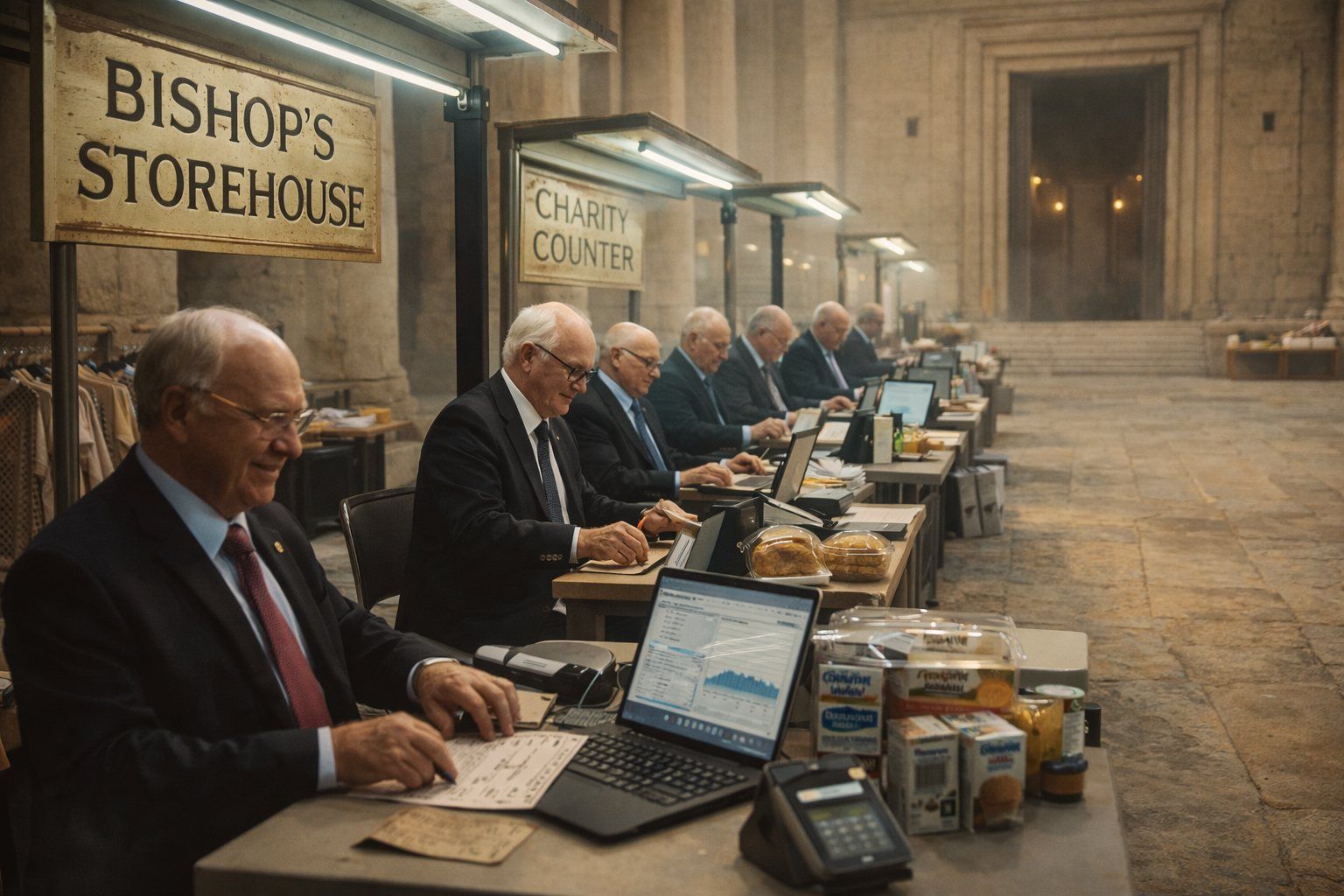
Anyone who has spent time in the buildings knows the texture of it. The carpet worn to the weave in the hallway. The folding tables. The volunteer with a vacuum on a Saturday, because there is no budget for a cleaner. The aging congregation carrying the load of a building older than most of them. The deferred repair everyone has stopped mentioning. This is the institution as it is felt — frugal, modest, a little threadbare, sustained by unpaid hands.
The Office does not dispute the feeling. It disputes the conclusion drawn from it. The lived austerity of the meetinghouse is taken, by the members who live it, as evidence that the institution is careful with money, perhaps even short of it. It is evidence of no such thing. It is evidence of a choice about where money is allowed to be visible.
Between fourteen and seventeen thousand of these buildings stand in the United States. Each is held free and clear by an institution whose central reserve is estimated near two hundred billion dollars and grows, by the Office’s reckoning, some twenty billion in a year. The worn carpet and the sovereign fund belong to the same owner. They are not in tension; they are in arrangement. The scarcity is experienced locally, at the edge, by the members. The abundance is preserved centrally, out of sight, by the leadership. The one is the cost of the other’s invisibility.
This is what the older word chintziness is for, and why the Office prefers it to a softer term. Chintziness is not merely having little. It is having much and parting with little — the refusal of what an older anthropology called the potlatch, the obligation of the powerful to spend their surplus back into the people who produced it. Marcel Mauss described societies in which a chief’s standing depended precisely on his willingness to give away, even to destroy, what he had accumulated; in which hoarding was the disgrace and distribution the honor. Measured against that older standard — and against the institution’s own founding image, the multiplied loaves, the abundance handed out without metering — the arrangement inverts the mythology exactly. The figure it takes its name from fed crowds from nothing. The institution keeps two hundred billion against a day it will not name, and lets the carpet wear through.
Why keep it worn, when a rounding error would recarpet every hallway in the country? Because visible generosity would spend down the thing that visible austerity protects. A church that appeared as rich as it is would have to answer for the reserve. A church that appears frugal is asked no such question — the frugality is the answer, offered in advance, in the form of a folding table. The austerity is not the absence of the wealth. It is the wealth’s disguise. And the members, cleaning the building on a Saturday, are not witnessing the institution’s poverty. They are performing it.
One click copies the complete, sourced text. Paste it into Claude, Kimi, ChatGPT, or any AI session and ask your questions there. Even our longest document fits in one paste.
Sources
- State of LDS Finances — 2026 (chapel inventory; the visible-vs-invisible asymmetry). Annual Report.
- Marcel Mauss, The Gift (1925) — the potlatch and the obligation to spend.
- The framing thesis — The Argument.