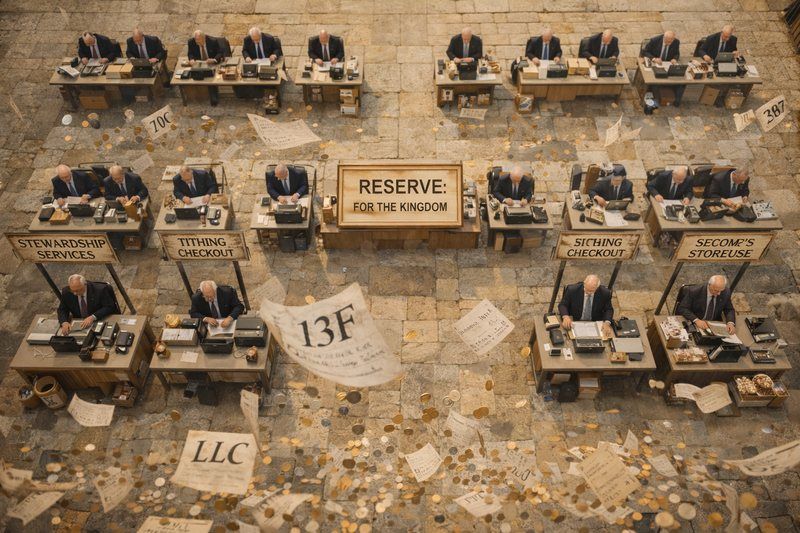
In March 2013, a new employee of Ensign Peak Advisors, the investment arm of the Church of Jesus Christ of Latter-day Saints, sat down to an orientation deck. The deck was internal, never meant for members. It explained that the staff worked as stewards in the Lord’s storehouse, managing the church’s investment reserves under the direction of the First Presidency and the Presiding Bishopric, and it listed the fund’s four charges: to fund prophetic initiatives, to supplement the operating budget, to backstop the pension plan, and to serve as collateral for church purposes. A companion presentation from the same season, later recited by a federal appeals court, gave examples of the reserve’s withdrawals: City Creek, one point four billion dollars over five years, for a shopping mall, and Beneficial Life, six hundred million dollars in 2009, for a failing insurance company. This is documented: the deck and the slide are exhibits to the 2019 whistleblower complaint, and the slide figures were recited by the Ninth Circuit, sitting en banc.
Now set beside that slide the sentences the membership heard. April 2003, general conference, President Gordon B. Hinckley: tithing funds have not and will not be used to acquire this property, nor will they be used in developing it for commercial purposes. October 2004: tithing funds will not be used for this construction. A Presiding Bishop told the press: none of this money comes from the tithing of our faithful members; that is not how we use tithing funds. These are documented, drawn from the conference record and from the court’s own recitals.
Between the slide and the sentences stands the question of this essay. Not whether the one legally contradicts the other, since an en banc court ruled in 2025 that no reasonable juror could call the public statements fraudulent, because the reserve’s earnings alone could cover the earmark, and money in a treasury is fungible; that is documented, and it is genuine counter-evidence. The question is older and larger: how did an institution that the United States spent sixty years dismantling, whose prophet was murdered, whose economy was seized, whose voters were stripped of the franchise, whose apostle was made to beg a Senate seat for four years, come to hold a reserve so large that a billion dollars for a mall could move through it without any member being told, and to hold it in a structure the Securities and Exchange Commission later found was built for the sole purpose of preventing public disclosure?
What happened? The short answer is that the kingdom survived its own defeat by changing its form. The long answer is a genealogy.
One. The kingdom in the open
Begin with the founding grammar. The first section of the Doctrine and Covenants, the movement’s own canon, declares it the only true and living church upon the face of the whole earth, with which I, the Lord, am well pleased. Only. Living. The whole earth. This is not the grammar of a denomination asking for a pew in the American religious marketplace; it is the grammar of a claimant.
And the claim came furnished.
Joseph Smith, the Council of Fifty, and the Kingdom of God, 1842 to 1885
Part one. The ground: a city-state on the Mississippi
From the record. Nauvoo’s charter passed the Illinois legislature in December 1840. It let the mayor sit as chief justice of the city court and issue writs of habeas corpus, and it allowed the city to raise its own militia, the Nauvoo Legion. By 1842 the Legion had about 2,000 men, and within two years nearly 3,000. That same year the United States Army had fewer than 8,500 soldiers. By 1844 Joseph Smith was at once church president, trustee of church finances, mayor, chief justice, lieutenant general of the Legion and registrar of deeds. That last office existed under neither Illinois law nor the charter. Quinn, Origins of Power, pages 105 to 110.
Quinn’s reading. Puritan ministers couldn’t hold civil office in Massachusetts Bay, so Quinn calls Nauvoo the first ministerial theocracy in American history. Origins, page 106.
Part two. The revelation that named the kingdom, 1842
From the record. On 7 April 1842 Smith received a revelation naming a future governing body: “The Kingdom of God and His Laws, with Keys and power thereof, and judgment in the hands of his servants, Ahman Christ.” Its full text is unknown. That July, as editor of the Times and Seasons, Smith wrote that under Moses and Aaron, civil and church affairs “were both one; there was no distinction.” He wrote that the same would hold when God’s purposes were fulfilled. Within days of that revelation, he also wrote to Sidney Rigdon’s nineteen-year-old daughter that “whatever God requires is right, no matter what it is.” Origins, pages 111 to 112.
Quinn’s reading. Before 1842, Mormon writers like Parley Pratt read the kingdom of God in Daniel as a spiritual kingdom, put off until the Second Coming. Smith changed that in 1842, and Quinn treats the letter to Nancy Rigdon as the first written statement of Smith’s “theocratic ethics.”
Part three. The temple covenants: the Anointed Quorum
From the record. On 4 and 5 May 1842 Smith gave the first “holy order” endowment to nine men. They included Hyrum Smith, Brigham Young, Heber C. Kimball, Willard Richards, William Law and William Marks. Several were longtime Freemasons. James Adams was Deputy Grand Master of the Illinois Grand Lodge. Smith, Law, Marks, Young and Richards had become Masons only weeks earlier. The ceremony included washing and anointing, robes, signs and tokens, and covenants.
On 27 August 1843 Smith tied the highest ordinance to government. He said those holding the fulness of the priesthood are “kings and priests of the most High God.” His diary adds the phrase “a perfect law of Theocracy.” Between 28 September 1843 and 26 February 1844, Smith and eighteen other men received the second anointing, along with their wives. Origins, pages 113 to 115.
From the record. By late 1843 the Anointed Quorum had become a political forum, and women voted in it. On 15 November it approved a petition to Congress. On 3 March 1844 it chose James Arlington Bennet as Smith’s running mate. Quinn says these were the only known times women took part in Mormon theocratic decisions. Origins, pages 115 to 118.
From the record, on loyalty. After Smith’s death the endowment included an oath of vengeance. George Q. Cannon told his son that when he received his endowment in Nauvoo, he took an oath against the Prophet’s murderers. On 21 September 1857, days after Mountain Meadows, Council of Fifty member Phineas Richards told a Salt Lake prayer circle, “We have covenanted to avenge the blood of the Prophets.” Quinn, Extensions of Power, around page 249.
My inference. Quinn never uses the phrase “covenants of loyalty” in these passages. What he documents is two separate things. First, ritual oaths of secrecy layered on top of one another. Second, a post-1844 endowment oath of vengeance.
Part four. The 1844 presidential campaign
From the record. The Quorum of the Twelve privately nominated Smith for president on 29 January 1844. Smith told them, “There is oratory enough in the Church to carry me into the Presidential chair the first slide.” His platform was called Views of the Powers and Policy of the Government of the United States. It proposed:
- a smaller and lower-paid Congress
- prison reform built on work and job training
- a national bank
- buying the freedom of enslaved people with money from public land sales
- annexing Texas and Oregon
- presidential power to step into civil unrest within a state
Copies went to the president, the cabinet, the Supreme Court, Congress and the newspapers.
On one day, the Twelve assigned 337 political missionaries to twenty-six states and Wisconsin Territory. Quinn says the church didn’t send that many missionaries in a single year again until 1895. The Mormons first chose Bennet as running mate, but he was born abroad. Colonel Solomon Copeland of Tennessee was next. Sidney Rigdon was the third and final choice, named by the Council of Fifty on 6 May. Origins, pages 117 to 120 and 133 to 135.
Quinn’s reading. Smith hoped to act as a spoiler. If no candidate won a majority in the Electoral College, the House would choose the president, as it had chosen John Quincy Adams in 1824. Smith could then bargain for Nauvoo’s protection. Heber C. Kimball and John S. Fullmer both wrote that they knew Smith couldn’t win in 1844. Origins, pages 135 to 136.
Part five. The founding of the Council of Fifty
From the record. The trigger was a letter Smith read on 10 March 1844 from Lyman Wight and George Miller. They were cutting lumber for the temple in the Wisconsin pineries, and a United States Indian agent was blocking them. Wight asked to move his men to the Republic of Texas, outside United States law.
That same day Smith held a preliminary meeting. His diary reads: “Can this council keep what I say, not make it public, all held up their hands.” On 11 March he organized a “special council.” It began with twelve men who had received the second anointing and ten other Mormons. Women were not members. On 13 March Smith became “standing chairman,” Willard Richards became recorder, and William Clayton became “Clerk of the Kingdom.” Two days later the Times and Seasons said the church “must not triumph over the state, but actually swallow it up.” Origins, pages 120 to 122.
The names. The 1842 revelation gave the council its formal name, so members called it “the Kingdom of God” or “the Council of the Kingdom.” Once it reached fifty it was usually called the Council of Fifty. George Miller called its members “fifty princes of the kingdom.” The official History of the Church hid it under the term “General Council,” which had several other meanings. Quinn says no member ever used that term in a private diary. Members also wrote it “Council of YTFIF,” “Council of L” and “Q of F.” Origins, page 120 and note 86.
Its stated purpose. A later revelation to the council, dated 27 June 1882, gave its purpose. It was for “the establishment of my rule, for the introduction of my law, for the protection of my Church,” and for civil and religious liberty “in this nation and throughout the world.” The council accepted it as the word of God, but it was never canonized. Origins, page 122.
The constitution that wasn’t written. A committee spent a week trying to write a constitution for the kingdom, modeled on the United States Constitution. On 18 April it admitted failure. Smith answered with a revelation: “Ye are my constitution.” Orson Pratt later told the council it had “a living constitution not a written one.” Members sometimes called themselves “the Living Constitution.” Origins, page 131.
The rules. Business needed a quorum of half the members, and every decision had to be unanimous. The chairman voted first, then each member in order from oldest to youngest. Anyone who dissented had to change his vote to match the rest. Origins, page 131.
Quinn’s reading. He compares the council to a king’s council, the Curia Regis of medieval monarchies, because it met only when its chairman called it. He says that voting order “encouraged a snowball effect.” Origins, pages 122 and 131.
Part six. The anointing of Joseph Smith as king
From the record. On 7 April 1844, the day after the council commissioned Orson Hyde as its secret envoy to Washington, Sidney Rigdon told general conference: “A man is not an honorable man if he is not above all law, and above government.”
Four days later came the council meeting of 11 April. Clayton’s diary entry for that day is short: “voted our P P and K with loud Hosannas.” His fuller summary, dated 1 January 1845, reads: “was prest. Joseph chosen as our Prophet, Priest and King by Hosannas.” William Marks was present. He said in 1853 that the council performed an ordinance “in which Joseph suffered himself to be ordained a king, to reign over the house of Israel forever.” All three non-Mormon members were there and voted. Origins, pages 123 to 124 and 128, with notes 101 and 102.
What the 1844 record does not show. No surviving 1844 document describes the ceremony itself. Quinn rebuilds it from a later one. On 4 February 1885 Lorenzo Snow consecrated a bottle of oil, George Q. Cannon anointed John Taylor, and all present laid hands on him. They ordained Taylor “a King, Priest and Ruler over Israel on the Earth.” Quinn writes that this “also probably” describes what was done in 1844. That word “probably” is Quinn’s own. Origins, note 105.
The objection Quinn answers. Some writers say critics confused the council event with the second anointing, which made a man a king and priest in heaven. Quinn’s reply is that Smith had his second anointing almost six months before 11 April, so the April event was something else. He also cites the 1882 revelation, which says God called Smith “to be a King and Ruler over Israel.” Origins, page 124.
A source Quinn rejects. One statement often quoted is “in this Council we ordained Joseph Smith as King on earth,” attributed to George Miller in an 1855 letter. Quinn checked every published version of Miller’s letter and found no such line. He concludes that John Zahnd, a later schismatic, apparently made it up and inserted it into his manuscript copy. Origins, note 102.
From the record. Three days after the anointing, Smith wrote to the non-Mormon press that he favored “THEO-DEMOCRACY, where God and the people hold the power.” Wight and Kimball wrote to him in June 1844 that “you are already President Pro tem of the world.” The History of the Church cut both passages. Origins, pages 124 to 125 and notes 106 and 107.
Part seven. Who was in the room
From the record. Fifty members stood before Smith on 18 April 1844. He told them, “Now we have the number which the Lord requires, but we will take a few more on our own hook.” In all, he brought in fifty-three men.
Only three were not Mormons:
- Uriah Brown, aged fifty-nine, a judge who had invented a “liquid fire to destroy an army or navy.” He ranked fifth in the council and chaired the Nauvoo political convention that nominated Smith.
- Edward Bonney, a Freemason and Smith’s aide-de-camp. A biography Quinn cites says Bonney passed counterfeit bills.
- Marinus G. Eaton, another counterfeiter. On 23 March 1844 he warned Smith of a plot by dissenters.
Origins, pages 125 to 128.
The numbers Quinn gives for Smith’s appointees:
- Eighteen had been Danites in Missouri, about a third of the council.
- Eighty-five percent appear in the records of the main Nauvoo Masonic lodge.
- Twenty-two, or 41.5 percent, had not received the endowment.
- Seventy percent were monogamists.
- At least 15 percent were bound by four separate secrecy oaths: Danite, Masonic, endowment, and the council’s own.
Origins, pages 129 to 131.
The oath. Smith’s diary for 10 March says, “Joseph required perfect secrecy of them.” Initiates “covenanted before God with uplifted hands.” Later official minutes describe the initiation as “the Charge, the name, and Key word, and the Constitution, and Penalty.” In 1844 dissenters said the members were sworn to secrecy “under the penalty of death.” Origins, pages 128 to 129.
Quinn’s reading. The word “Penalty” in the official minutes backs up the dissenters’ claim of a death penalty for disclosure. He says Smith chose Masons because a Mason who betrayed the council would also be betraying a fellow Mason, Smith himself, so the two oaths reinforced each other. Quinn also says the council was not a continuation of the Danites. Still, he finds the Danite oaths, their use of the number fifty, and their reading of Daniel too alike to be coincidence. Origins, pages 129 to 131.
Who was left out. No member of the First Council of Seventy was admitted. Neither were some men Smith trusted to guard his plural wives, including Lorenzo Snow and Isaac Morley. Origins, page 130.
Part eight. The kingdom’s foreign policy
From the record.
- Washington: Orson Hyde carried a memorial asking Congress to let Smith raise “one hundred thousand armed volunteers.” The force would protect Texas and Oregon. The memorial also asked for two years in prison for anyone who interfered with Smith’s “designs.” Hyde met senators on 24 April and the president on 25 April. He wrote, “If the Saints possess the kingdom I think they will have to take it.”
- Texas: Lucien Woodworth negotiated with President Sam Houston for land to settle. The Texan Congress was to ratify the deal that fall.
- England: Amos Fielding.
- France: Almon W. Babbitt.
- Russia: George J. Adams, whose mission Babbitt later tied to Uriah Brown’s weapon.
The missions to England and Russia went out with ordinary missionary certificates as cover. Origins, pages 123 and 132 to 134.
Quinn’s reading. Smith meant to play Britain, France, Russia, Mexico and the United States against one another over Texas, Oregon and California, much as he had played Whigs against Democrats in Illinois. Quinn calls it “a dangerous game.” He also says Smith’s moves in 1844 were neither desperate nor megalomaniac. Origins, pages 134 and 137.
Part nine. Betrayal, the Expositor, and Carthage
From the record. On 18 April 1844 the council handed William and Wilson Law and Robert D. Foster over “to the Buffitings of Satan.” Thirty minutes later, twenty-four council members sat on the church court that excommunicated them.
On 12 May Smith preached that he would “lay a foundation that will revolutionize the whole world.” The Expositor’s prospectus referred to a “SELF-CONSTITUTED MONARCH.” Its first issue, on 7 June, said: “We will not acknowledge any man as king or lawgiver to the church.” Wilson Law was later heard saying that the kingdom in Daniel had already been set up and that Smith was its king. Origins, pages 125 to 126 and 137 to 141.
From the record. Smith never called the council during the Expositor crisis, even though enough members were in Nauvoo to make a quorum. On 22 June he told Clayton he could burn the council’s minutes. Clayton didn’t. Smith left Nauvoo, but two council members, Reynolds Cahoon and Lorenzo Wasson, called him a coward, and he came back. On the morning of 27 June he ordered Jonathan Dunham to lead the Legion against Carthage. Dunham refused and told no one. Origins, pages 139 to 141.
Quinn’s reading. Members of the council had betrayed its secret. Smith no longer trusted the council as an institution, “and without that trust his grand designs for the Kingdom of God collapsed.” Origins, pages 139 to 140.
Part ten. After Joseph: the council under Brigham Young
From the record. On 4 February 1845 Young became standing chairman. He dropped all three non-Mormons, along with Rigdon, Marks, Wight and others. Of his twenty appointees in 1845, at least seven were former Danites. On 1 March 1845 the council voted to fulfill “Josephs measures” by going west to a place where the Saints could “live by the laws of God.” Extensions, pages 226 to 231.
From the record. Sometime between 6 December 1848 and 9 February 1849, the council ordained Young as its king. On 12 February 1849 he called himself “King & Prest.” In 1850 William Smith, Joseph’s brother and a former apostle, wrote that Young was “crowned a King” in “a secret lodge of 50 men.” Extensions, pages 238 to 239.
Quinn’s reading. The “throne” in William Smith’s charge was a polemical invention, but the kingship was real. Late 1848 to mid-1850 was the council’s heyday. After that, Young let it lapse for more than fifteen years. He never gave it decision-making power, and he kept it under the Twelve. Extensions, pages 238 to 240.
From the record. Young brought the council back on 23 January 1867. Its vote to found ZCMI in October 1868 came after the general conference had already approved it. In 1874 he preached, “I shall not tell you the names of the members of this kingdom.” Extensions, around pages 278 to 281.
Part eleven. John Taylor’s revival and the end
From the record. John Taylor reconvened the council on 10 April 1880. It met four days that year, four in 1881, ten in 1882, eight in 1883 and four in 1884. Its business included:
- arranging unanimous nominations of approved candidates
- debating whether to allow “minority representation” for non-Mormons at a state constitutional convention
- defeating motions by William H. Hooper and Apostle John Henry Smith to make the Democratic Party the church’s new political party
- forming election committees for Idaho and Nevada
- assessing Utah counties for a defense fund for men charged with polygamy
On 11 October 1882 the First Presidency and apostles chose John T. Caine as their candidate for delegate to Congress. Three hours later the council “fully discussed” the question and “nominated” him. Extensions, pages 292 to 294.
From the record. By 1884 business sometimes stopped because most members were absent. The council last met on 9 October 1884. On 4 February 1885 Taylor was anointed king by council members. No one was added after 1884. The last surviving member was Heber J. Grant, who died in 1945. Extensions, page 299 and Appendix 3.
Quinn’s reading. After 1844 the hierarchy ran “a shadow government behind the Fifty’s shadow government.” The members who wrote most glowingly about the council were those who never saw the apostles stage-managing it. Between 1844 and 1884 the council took in every member of the First Presidency except William Law and every apostle. By 1883 one member called it a council of the church’s presiding authorities. Quinn notes that description could never have fit Joseph Smith’s council, with its three non-Mormons. Extensions, pages 293 to 295.
Part twelve. The appendices
Origins, Appendix 5, ranks the members as of Smith’s death on 27 June 1844, and again a year later. Each name comes with a short background: Danite, Mason, Anointed Quorum, plural marriage ties, campaign role, and where the man was during the martyrdom.
Extensions, Appendix 3, is an alphabetical list of every appointment from 11 March 1844 through 9 October 1884. It gives admission and release dates. Its entries record three kingly ordinations or anointings:
- Joseph Smith, 11 April 1844
- Brigham Young, before 12 February 1849
- John Taylor, 4 February 1885
Lewis Dana, an Oneida admitted 1 March 1845, is listed as the council’s one American Indian member.
My count. Appendix 3 has about 140 names. That figure is my tally, not Quinn’s. It includes John Phelps, who attended only the 10 March meeting and was never admitted.
This matters because everything after 1844 is a negotiation between the claim and the catastrophe. The claim was never withdrawn. It still stands in the canon, unrevised, in the first section. What changed, what had to change, was the form in which a defeated kingdom could keep it.
Two. The four-year inquisition
The standard chronology is a sixty-year war, and the church lost every battle of it. Carthage, 1844: the king dead. The exodus of 1846 to ’47: the kingdom relocates to a desert so unpromising that no army would follow it. The Utah War, 1857: a federal army marches on Zion anyway. The Morrill Act of 1862, the Edmunds Act of 1882, the Edmunds-Tucker Act of 1887: the kingdom’s signature institution criminalized, its property escheated to the United States, its voters disenfranchised, its leaders driven underground, in what was called the Raid. The Manifesto of 1890: surrender, in language stripped of all prophecy. I hereby declare my intention to submit to those laws, Wilford Woodruff wrote, and to use my influence with the members of the Church over which I preside to have them do likewise. Statehood in 1896 was absorption on the victor’s terms.
Then the coda, and it is the instructive part. From 1904 to 1907 the United States Senate spent four years deciding whether Reed Smoot, an apostle of the newly domesticated church, could hold the seat Utah had elected him to. The hearings were an inquisition into the surviving form of the claim. The charge, as one witness framed it, was that the church president’s word, taken as divine proclamation, carried far more weight in Utah than the Constitution or any law Congress might pass. The Salt Lake Ministerial Association put the Protestant establishment’s protest in the exact phrase D. Michael Quinn preserves: the church’s ruling council claimed supreme authority, divinely sanctioned, to shape the belief and control the conduct of those under them in all matters whatsoever, civil and religious, temporal and spiritual. And Senator George Hoar of Massachusetts posed the question that has never been answered since, to church president Joseph F. Smith himself: which, as a matter of obligation, is the prevalent authority, the law of the land or the revelation? Smith answered: well, perhaps the revelation would be paramount. Hoar pressed: perhaps? This exchange is documented.
Smoot kept his seat in 1907. But the interrogation had made its point, and the church understood it perfectly: the kingdom would be tolerated only on condition that it testify, under oath and at length, that it was no longer a kingdom. The open form had to die. What happened next is what this essay is about, because the claim did not die with it.
Three. The transvaluation
Here is the first of two borrowed instruments this essay uses, and it is Nietzsche’s. In On the Genealogy of Morals he describes how a defeated priestly will to power survives defeat: it converts its impotence into a new order of values in which its own qualities become the standard by which everything else is judged. It cannot prevail in the world’s terms, so it changes the terms. What it cannot do becomes what one must not do; its weakness is rebaptized as virtue, its discipline as holiness, its obedience as the price of belonging. The test of the instrument is whether it explains the record better than the record explains itself.
Watch what the church built between the surrender and the Second World War. The open kingdom had governed bodies directly, land, labor, marriage, courts. The transvalued kingdom governed something more portable: the member. Tithing ceased to be a frontier donation and became a recorded payment, an annual account between the individual and the institution. In 1921 the Word of Wisdom, the 1833 dietary counsel that had stood for ninety years as counsel only, was hardened into a requirement and tied to a specific instrument: the temple recommend. The recommend is a small laminated certificate of worthiness, renewed by interview, and Heber J. Grant’s administration made the church’s whole ritual economy run on it. In 1936 the Church Welfare Program went churchwide, a genuine mutual-aid apparatus, and also a registry of need and labor. One by one the instruments assembled a population that was legible: every member’s payment, abstinence, worthiness, and want existed as a record the center could read.
It is crucial to say what this produced, because the product is the point. A century of such disciplines does not produce zealots. It produces people who are punctual, sober, debt-averse, interview-hardened, and certified by their community as trustworthy. This is where the second instrument comes in, and it is Weber’s. Charisma, Weber observed, does not survive its founder; it routinizes into office and procedure. Matthew Bowman invokes Weber’s own phrase, the routinization of charisma, for exactly this Mormon transformation. And in his American writings Weber noticed something subtler: sect membership in America functioned as a certification of character, a credit rating issued by a community, since admission to the congregation was a vetting that the market could bank on. The Mormon transformation is the Weberian one, squared: the church became a machine for manufacturing bankable character, and then, this is the move the kingdom makes, it became the bank.
The asceticism, notice, had changed hands. The open kingdom had asked the member to consecrate property to Zion. The transvalued kingdom asked the member to consecrate a tenth, keep the dietary code, hold the recommend, and endure the interviews, while the institution’s own relationship to wealth moved somewhere the member could not see. Nietzsche’s ascetic priest despises wealth; the modern corporate form found something more efficient. It assigned the asceticism to the flock. This reading of the pattern is offered as interpretation; the pattern itself is documented.
Four. The corporate form
The second transformation is Harold B. Lee’s. Beginning around 1960, the church built Correlation: the centralization of all authority and the standardization of all curriculum, self-consciously on a corporate model. Under Correlation, every manual, every magazine, every children’s lesson, every priesthood syllabus flows from one committee; every congregation on earth teaches the same lesson on the same Sunday from the same text. The doctrinal retrenchment that traveled with it, Joseph Fielding Smith’s conservatism, Bruce R. McConkie’s Mormon Doctrine, fixed the content; Correlation fixed the channel. A church that had once exported a people now exported a product: the same church, everywhere, indistinguishable, franchised. This reading is interpretation; the program and its dates are documented.
Two other instruments of the same period deserve naming, because they complete the form. The first is the archive. A church that baptizes the dead by proxy is, of necessity, the largest genealogy operation on earth: names are records, ordinances are entries, and the work runs on microfilm. The Granite Mountain Records Vault, blasted into a canyon outside Salt Lake City, is its physical monument, a records fortress of a kind no other American denomination built. When the National Security Agency later built its Utah Data Center at Bluffdale, nicknamed Bumblehive, the state’s own archive of everything it could collect, it planted it in the same desert valley. The two vaults are documented; the twinning between them is offered only as an analogy, a heuristic and nothing more.
The second is the security state. The courtship was mutual and early: J. Edgar Hoover’s absolutist anticommunism recruited religious allies, and Mormons, disciplined, teetotaling, vettable, were recruited eagerly. Bowman’s chapter on Mormonism and the FBI argues that Mormons fused piety with patriotism and were courted by the national-security agencies, until the post-Watergate decades turned the same squeaky clean image into a mark of suspicion. The chapter’s perfect emblem came in September 1984, when the FBI’s worst Mormon espionage case broke: agent Richard Miller, and the man who elicited his confession was Richard Bretzing, the bureau’s Los Angeles field director and a Mormon bishop, church office and state office occupying one conscience. Ezra Taft Benson, the apostle who carried absolutist anticommunism into the hierarchy’s highest councils, spent those years being managed by his own institution as much as by the agencies that courted him, since the transvalued kingdom had learned to police even its own zeal, because zeal in the open form was what had nearly killed it.
By the late 1970s the transformation was complete: a centralized, correlated, media-fluent church whose members were the most certified citizens in the republic, whose archive was bomb-proof, and whose relationship with the state’s intelligence and law-enforcement organs was a matter of personnel. What it did not yet have, what the open kingdom had lost forever in 1890, was sovereignty. What it was about to acquire was something the nineteenth century had never imagined: a treasury that answered to no one.
Five. The priest-kings
From 1980 to 2018, the working years of Gordon B. Hinckley and Thomas S. Monson, the form reached its completion, and the men are the proof. Not because they were cynical; the record shows sincerity, devotion, warmth. Because the office they built and held did what Nietzsche said the priest’s office does: it made the priest indispensable at every threshold of the member’s life, and it fed the treasury in God’s name. Consider the documented skeleton.
The regency. For most of thirteen years, from 1981 to 1994, the church’s highest office was exercised by counselors in the name of presidents who could not exercise it. Dew’s authorized biography says it in plain words: by mid-1982 the day-to-day responsibilities of the First Presidency had shifted almost entirely to President Hinckley. Hinckley’s own journal, quoted in the same book, is plainer: the president of the Church is unable to handle any detailed matters of business. And on May 23, 1989, with Ezra Taft Benson incapacitated, two Certificates of Authority were executed giving Hinckley and Monson power of attorney over the Corporation of the President, the corporation sole that holds the church’s assets, expressly not affected by the president’s disability. Benson’s signature was produced by a signature machine. The documents were filed with the State of Utah; the members were never told; the arrangement surfaced only when the Salt Lake Tribune found it in 1993. This is documented: Quinn cites the state corporate file by number, and the Tribune story ran August 15, 1993. Two counselors held legal title to rule in a third man’s name, with no outside check. The ecclesiastical word for this is counselors’ faithfulness. The structural word for it, offered here as interpretation, is regency.
The machinery. When N. Eldon Tanner died at the end of 1982, his duties, many of which concerned Church financial management, Dew writes, shifted to Hinckley, who also chaired the Budget and Appropriations Committee, which met weekly to consider all major Church expenditures. Bishop Robert D. Hales, later the Presiding Bishop, credited Hinckley’s influence on the investment strategy of the Church as nothing short of remarkable. Monson, in his first weeks as a counselor in late 1985, attended his first Investment Policy Committee meeting, the only mention of the investment apparatus in Swinton’s entire authorized biography. All of this comes from the authorized books themselves, Dew and Swinton, and is documented. Both priest-kings sat inside the treasury their whole careers.
And in 1982, the same year the duties changed hands, a proposal to resume publishing financial statements, silent since 1959, died in a meeting. The church’s own managing director of investments, J. Alan Blodgett, was present and later wrote the account down: leaders feared that individual members may not understand the vastness of Church resources and operations, and that the information might negatively influence their faithfulness; and, the account continues, President Monson, then a member of the Quorum of Twelve, so expressed himself once in a meeting held just prior to President Tanner’s death, putting an end to a proposal made in 1982 to publish financial statements. This is one account, first-hand, uncontradicted by any document, and it states the motive in the participant’s own words: the flock must not see the vastness. It is alleged rather than corroborated, though it is first-hand, and no second source for it exists.
The two registers. What the public heard, meanwhile, was the opposite of vastness. In 1985, at general conference: the Church does have substantial assets, but it should be recognized that all of these are money-consuming assets and not money-producing assets; when all is said and done, the only real wealth of the Church is the faith of its people. The same year, in East Berlin, asked by a minister of the German Democratic Republic how his church was rich enough to build in their country, Monson answered that the Church was not wealthy but followed the ancient biblical principle of tithing. This is documented, from Swinton’s own biography, not wealthy, said to a foreign ministry, while the reserve that would become Ensign Peak was already being built by a fixed percentage of income. In 1991 came the one public description of the machinery: a fixed percentage of the income will be set aside to build reserves against what might be called a possible rainy day. The existence of the reserves was never denied, that is true, and this essay does not deny it. What was withheld, always, was the size; and the size was the point.
The vault. In August 1997 Time put Mormons, Inc. on its cover and estimated the church’s assets at a minimum of thirty billion dollars. On September 29, 1997, one month later, an interval the whistleblower complaint calls one reactionary month, Ensign Peak Advisors was incorporated, with Hinckley, Hales, and Henry B. Eyring as its trustees. This is documented, from the articles of incorporation and the SEC order. At inception it managed about seven billion dollars. Then the SEC’s 2023 order, the hardest paper in this whole record, takes over the narration. From 1997 through 2019 Ensign Peak failed to file the required Forms 13F; instead the church and Ensign Peak created thirteen shell LLCs for the sole purpose of filing Forms 13F and preventing public disclosure by Ensign Peak of the Church’s equity securities holdings. Ensign Peak did not have the authority to implement this approach without the approval of the Church’s First Presidency. The 2005 approval came with the instruction that better care be taken to ensure that neither the Street nor the media could connect the new entity to Ensign Peak. Business managers were chosen for common names and a limited presence on social media. And paragraph 31 of the order states: unanimous approval from the senior leadership of the Church was required before Ensign Peak could deviate from the LLC structure, which is to say the rule for ending the concealment was unanimity, so the concealment’s default state was locked. The approvals of 2001 and 2005 came from a body in which Hinckley and Monson sat; those of 2011 and 2015 from a body Monson presided over. The order names no individual, and this essay names none beyond what the order states. This is documented: SEC Release 34-96951; the church paid a five million dollar penalty over disclosure mechanics, and said it had relied on counsel, and that caveat stands.
The mall. City Creek is where the two registers collide in one property. Publicly, in 2003, 2004, and 2006: tithing funds have not and will not be used. Internally, the orientation slide read, City Creek, one point four billion dollars over five years, drawn from the reserve, routed through subsidiaries so that, per a sworn whistleblower declaration recited by the Ninth Circuit, people should not know EPA’s role as the source of the funds. The church’s legal answer, which prevailed, is that the money came from earnings on the reserve, and that reserve earnings are not tithing; the en banc court agreed no reasonable juror could find fraud, and that is documented, and is carried here as counter-evidence, not hidden. The whistleblower’s answer is that the treasury account in question held only never-invested tithing, and that money is fungible, money is fungible being the very phrase Blodgett had told the press back in 1991. The court did not decide which account the checks came from. What no one disputes is the shape of the event: a billion four hundred million moved from a hidden reserve into a mall while the president of the church assured the faithful, in conference, that tithing would not touch it, and the assurance and the transfer were both true only in a sense so technical that the assurance functioned, in practice, as its opposite. This last reading is interpretation, built on documented sentences.
The ring. And they were loved for it. That is the part the critical record keeps failing to hold: the warmth was real, the loyalty was real, the tears at the funerals were real. In 2004 the President of the United States hung the Medal of Freedom around Hinckley’s neck: the United States honors Gordon B. Hinckley for his devoted service to his church and to his fellowman. This is documented. The authorized biographies perform the adoration in print, and they are precisely what Nietzsche said a priestly law book is: a book of law never describes the uses, the reasons, and the casuistry in the prehistory of a law, because that would make it lose its imperative tone. Dew records the investment chairmanship and omits the 1989 certificates; Swinton records the Beneficial Life bumps, our corporations take the same bumps others do, and omits the six hundred million dollar infusion that Deseret Management disclosed four months later, let alone its source. Swinton’s most telling edit comes in reprinting Monson’s tribute to Hinckley from Dew: she drops the one sentence in which Monson admitted that Hinckley made decisions in an incapacitated prophet’s name, when President Kimball was unable to make some of the decisions that otherwise would have been his, President Hinckley knew what the prophet would want him to do, replacing it with an ellipsis while keeping the sentence that follows it. This is documented, by direct comparison of the two authorized texts. The hagiography is not lying about its subjects. It is doing to its subjects’ power what the subjects did to the treasury: holding it in reserve.
A church spokesman, asked in 2023 whether the reserve was secret, gave the form’s final answer: well, we don’t feel it’s being secret; we feel it’s being confidential. This is documented. The shepherd had learned to rename the wound.
Six. The twelve kept at the door
One more measurement, because it calibrates everything else. In 1980, when the Investment Policy Committee was formalized, its first vice chairman was Ezra Taft Benson, then President of the Quorum of the Twelve. The apostolic body had a seat at the investment table; this is documented, from Quinn. By 2013, per the internal Ensign Peak deck, the Investment Policy Committee consisted of the First Presidency and the Presiding Bishopric plus invited others, and, in the whistleblower letter’s own words, not even the other apostles are allowed to know the total assets that the COP parks at EPA. And the letter’s footnote preserves the exchange that gives the measurement its human scale: Boyd K. Packer, President of the Twelve and next in line for the presidency, went to Ensign Peak’s manager asking how much had been amassed, and was refused. I think I should know, I’m the most senior Apostle, I’m a breath away from being the next Prophet. He was sent away, the letter says, perturbed and unsatisfied. This chain is thirdhand, an Ensign Peak officer to the whistleblower to the letter, undated and uncorroborated, and this essay marks it as such; the letter is a whistleblower complaint, not an audited record.
Sometime between Benson’s vice chairmanship and Packer’s exclusion, the seat was lost. When, and by whose decision, is not in any document that could be found. But the arc is measurable at both ends, and it points the same direction as everything else in this section: power over the treasury contracted inward, toward the smallest possible circle, at the exact altitude where the kingdom’s claim is absolute. The apostles argue doctrine. The First Presidency holds the bank.
Seven. What the kingdom became
Monson’s decade as president, 2008 to 2018, shows the finished form operating in public. In June 2008 the First Presidency’s letter over Monson’s signature went into every California ward: we ask that you do all you can to support the proposed constitutional amendment by donating of your means and time. Proposition 8 was the open kingdom’s old mobilization run through the transvalued channels, the satellite broadcast, the coalition, the member funding measured in the tens of millions by outside estimates, and when the filings came due the church underreported its in-kind contributions and paid a five thousand five hundred thirty nine dollar fine to California’s Fair Political Practices Commission for thirteen counts of late reporting. This is documented. The moral army could still be mustered on command. What had changed since Nauvoo was only that the muster now ran through a 501c3 and a satellite uplink.
In November 2015 a leaked Handbook revision declared same-sex marriage apostasy and barred the children of such couples from baptism; Russell M. Nelson later described its adoption as the moment when the Lord inspired His prophet, President Thomas S. Monson, to declare the mind of the Lord and the will of the Lord. This is documented. Eighteen months after the policy, the church stated publicly that Monson, by then, is no longer attending meetings at the church offices on a regular basis; this is credibly reported, from the church’s own 2017 statement. Whether the counselor-regency pattern of the 1980s recurred behind the 2015 policies is a question the record in hand does not answer, and this essay does not pretend otherwise.
Then the treasury surfaced. In December 2019 the Nielsens’ complaint went public: Ensign Peak had grown from roughly ten billion dollars in 1997 to roughly one hundred one billion dollars, with, the complaint alleges, zero charitable distributions in twenty-two years. This is a whistleblower disclosure, not an audited statement, and that caveat travels with every figure it produced. In February 2023 the SEC settlement made the concealment architecture regulator-found: thirteen shells, twenty-two years, a five million dollar penalty for disclosure mechanics, resolved without admission or denial. In May 2023 the church’s answer went on 60 Minutes in Bishop Waddell’s sentence: we don’t feel it’s being secret; we feel it’s being confidential. In January 2025 the Ninth Circuit, en banc, ended the fraud litigation in the church’s favor. And the outside modelers, the Widow’s Mite Report and its successors, now put the reserve somewhere between one hundred fifty and one hundred seventy five billion dollars, and the institution’s total near a quarter of a trillion. These are extrapolations at plausible growth rates, not disclosures, and are flagged as such.
The resulting condition can be named exactly: the total is deliberately illegible, fragmented across jurisdictions and entities so that no single regulator, journalist, or member can read it whole. And it pairs with the asymmetry that any member can verify from a chapel pew: the visible ledger, building maintenance, local budgets, the felt prosperity of the ward, against the invisible one, the reserve’s compounding, the first shabby and the second monumental. The open kingdom built temples that bankrupted it, the Kirtland bank, the Nauvoo debts. The transvalued kingdom learned to keep its temples immaculate and its treasury invisible, and to fund the first from the second without ever saying so.
What is the form, then, at the end of the genealogy? Not a theocracy, since the open form died in 1907 and no one inside the institution mourns it aloud. Not a denomination, since no denomination keeps a records vault, a corps of certified administrators, a hundred-billion-dollar reserve, and a unanimous-approval rule for disclosing it. It is the thing the nineteenth century feared and the twenty-first cannot see: a kingdom that survives as an institution of evaluation and custody, certifying character, holding records, compounding reserves, and answering, when the state’s question is finally put to it, with a settlement and no admission. Senator Hoar asked which authority was paramount, the law of the land or the revelation. The question was never answered. It was administratively deferred, and the deferral now has a balance sheet.
Coda: the hammer
Nietzsche, who hated the priestly lie, refused to hate it cheaply. In the end, he wrote, it comes down to the purpose the lie is supposed to serve. So let the record answer him. The reserve’s purpose, per the orientation deck, is to fund prophetic initiatives, backstop pensions, and serve as collateral. Its unstated purpose, per the SEC and the fund’s own managing director, who explained the silence to the Wall Street Journal in 2020 by saying the church never wanted to be in a position where people felt like they shouldn’t make a contribution, is to keep the contributions flowing. That interview is credibly reported, and the SEC findings are documented. The lie serves the treasury, and the treasury serves the office, and the office, here is the hammer’s blow, is God. The king who was anointed in secret in 1844 and shot in June now sits in no jail and on no throne. He sits in a boardroom, trustee of a fund whose size his own apostles are not permitted to know, while the flock kisses the ring and pays its tenth and calls the deferral faith.
The nineteenth century destroyed the kingdom’s body. The kingdom’s will transvalued itself into the one form the victor could not criminalize: solvency, secrecy, and certified men. That is what happened. The defeated project of open dominion did not die. It incorporated.