
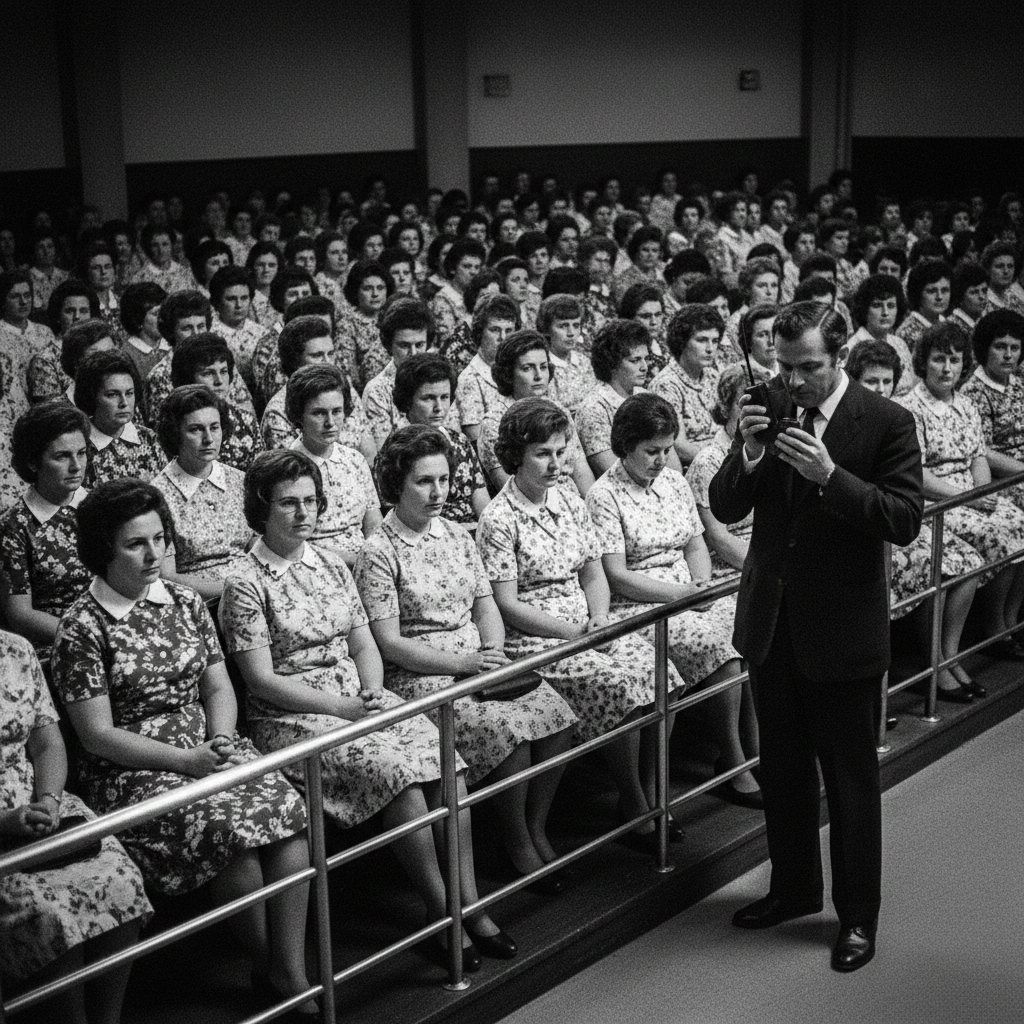
The two counts
The institution publishes one number: 17,887,212 members (year-end 2025), growing at roughly 1% a year. Membership, in that count, is a record — a name on a register, kept for life unless formally removed. What the register does not record is presence: attendance, activity, practice. The second number is never published.
The second number is the one that matters to every line of this office’s ledger. Per-member tithing, per-capita reserve share, temples per member, wards per member — all of them divide by it. So the Office reconstructs it.
Three independent series, one direction
Following the Widow’s Mite method — heterogeneous datasets indexed to 100 for comparability — three series that share nothing but the subject:
- Member donations in the five filing countries (Foreign Windows): donations per nominal member, diverging threefold across countries and softening over the last decade in most of them.
- Survey microdata (CCES, 584k US responses): self-identified affiliation and attendance, trended 2010–2024.
- Male missionary service: the rate at which young men of record age serve — the most behaviorally demanding activity marker the institution publishes inputs for.
Each series has its own biases; none has an obvious reason to conspire with the others. Their common finding: while nominal membership grew ~1%/yr, activity indicators declined from roughly 2016 onward, flattening the active count even as the register lengthened. National censuses tell the same story from a fourth direction: in Mexico, Canada, Australia, and the Philippines, residents who claim the affiliation to a census-taker number far below the institution’s reported membership for those countries.
The envelope
The triangulation lands where the Widow’s Mite reconstruction does: 3.8 to 5.4 million active members — call it a working midpoint near ~5 million, against 17.9 million nominal. Roughly 24% of the active live in Utah and Idaho; roughly half live in the United States.
That means the institution is, by presence, roughly a 5-million-member body carrying a 17.9-million-member register — and, correspondingly, that the reserve of ~$200–300 B is held against an active population a third the size of the publicized count. Per active member, the hoard is on the order of $37,000–79,000; per nominal member, ~$11,000–17,000. The institution quotes the nominal denominator when it speaks of scale and needs the active one when it plans a ward. The Office publishes both, and marks which it uses where (Methodology Annex).
The geography of the decline — a note for the next dispatch
The unit-count record adds a spatial fact: the active base is migrating. Ward creation and consolidation across US regions over the past five years — visible in the institution’s own published statistics — trace what the Widow’s Mite Report calls a “great migration” of active households, concentrating in the Intermountain West and select growth corridors while wards dissolve elsewhere. Roughly 1,100 chapels were removed from use 2019–2022 (Temples: The Capital Program). The denominator is not just shrinking relative to the register; it is moving.
The honest limits
“Active” is not a binary fact about a person; it is a constructed threshold, and reasonable constructions differ. The envelope is wide (3.8–5.4 M) because the series are indirect. The institution could settle the question tomorrow by publishing attendance; it does not, and the Office’s reconstruction exists for exactly that reason. What the Office will not do is quote the nominal count when the active one is the honest divisor — or pretend the envelope is narrower than it is.
One click copies the complete, sourced text. Paste it into Claude, Kimi, ChatGPT, or any AI session and ask your questions there. Even our longest document fits in one paste.
Sources
- The Church of Jesus Christ of Latter-day Saints, year-end 2025 statistics — 17,887,212 members; 32,046 wards and branches; 78,596 full-time teaching missionaries.
- Widow's Mite Report — Active Membership Indicators (three series indexed to 100) and U.S. Membership Trends ('a Great Migration'); methods adopted with attribution; active-membership envelope 3.8–5.4 M (2024).
- CCES survey microdata, Harvard Dataverse (584k responses; LDS affiliation and attendance fields); national censuses recording religious affiliation (Mexico, Canada, Australia, Philippines).
- Office dataset: data/membership-economics.csv (published with this series).