
The claim
The Office discloses that the institution is not only a church that participates in politics. It is a sovereign form operating beneath a religious exemption — with its own treasury, its own internal discipline and courts, its own foreign reach, and a political capacity it can deploy without visible authorship.
The historian’s own description
This is not a metaphor imposed from outside. Quinn’s Origins of Power (1994) is organized around it: “Theocratic Beginnings”; the chapter “The Kingdom of God in Nauvoo, Illinois”; the subsections “Joseph Smith for President,” “The Council of Fifty and Its King,” “The National and International Reach of the Kingdom.” Zion was always spatial; property was always jurisdiction. Land acquired under morally elevated language — gathering, consecration, kingdom then; stewardship, preservation, sustainability now — becomes harder to challenge politically. The moral vocabulary changes; the territorial function persists.
Sovereignty made quiet
Quinn’s later title states the mature form directly: “Church Security without Theocracy.” Formal theocracy can be abandoned while its practical goals continue through softer means — bureaucracy, legal insulation, political relationships, and disciplined internal loyalty. Sovereignty becomes distributed rather than declared. The kingdom is no longer announced; it is administered.
Force without a signature
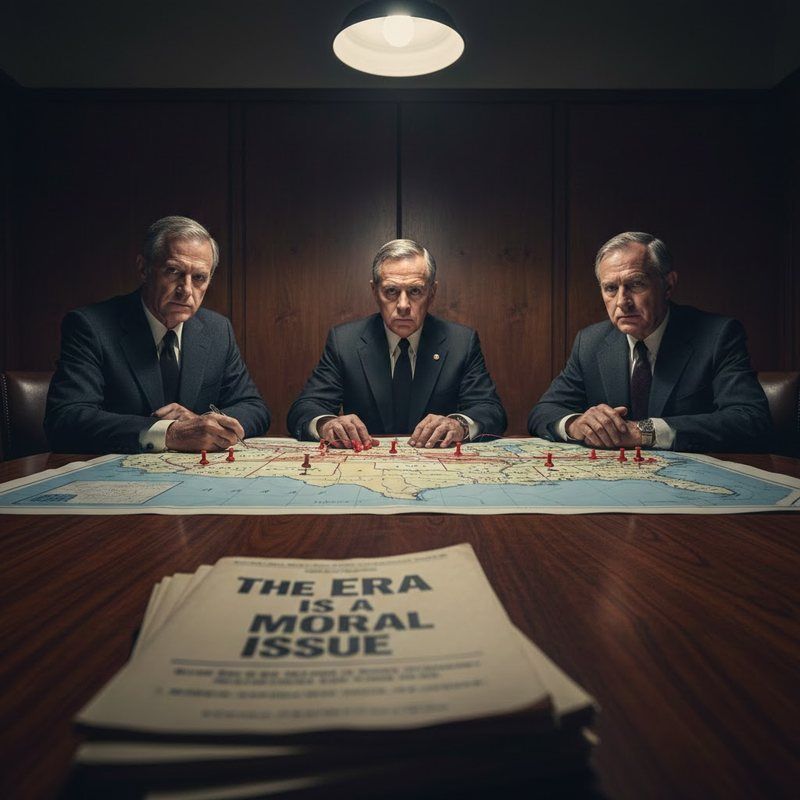

Extensions of Power (1997) moves from finance directly into “Partisan Politics” and “A National Force, 1970s–1990s.” The national campaign against the Equal Rights Amendment is the case study: how to mobilize institutional force while preserving the formal posture of religious neutrality. Quinn names the mechanism in a single subsection — “Covert Intervention.” The institution need not become a party. It can function as a disciplined mobilization network: financially centralized, culturally uniform, administratively coherent, already habituated to obedience. That is an unusually valuable coalition partner.
Dissent recognized in real time
The concentration of power was named from inside, in real time — not only by later historians. The 1844 Nauvoo Expositor, published once before it was destroyed, spoke of members who could no longer “cover and conceal that which… has been brooding among the ruins of our peace.” Cover and conceal is the institution’s own contemporaneous language for the thing the Vault now does at scale.
Disclosure
The Office discloses that the institution holds, in practice, the instruments of a small state — a treasury, a disciplinary apparatus, a foreign portfolio, and a deployable political capacity — while enjoying the legal protections of a church. It is a pseudo-state: sovereign in its own jurisdiction, and shielded in everyone else’s.
One click copies the complete, sourced text. Paste it into Claude, Kimi, ChatGPT, or any AI session and ask your questions there. Even our longest document fits in one paste.
Sources
- D. Michael Quinn, The Mormon Hierarchy: Origins of Power (1994) — “Theocratic Beginnings”; “The Kingdom of God in Nauvoo, Illinois”; “The Council of Fifty and Its King”; “Church Security without Theocracy.”
- D. Michael Quinn, The Mormon Hierarchy: Extensions of Power (1997) — Ch. 9 “Partisan Politics” (“Covert Intervention”); Ch. 10 “A National Force, 1970s–1990s” (the national anti-ERA campaign).
- Jane Mansbridge, Why We Lost the ERA (1986); Donald Critchlow, Phyllis Schlafly and Grassroots Conservatism (2005).
- The Nauvoo Expositor (1844).