
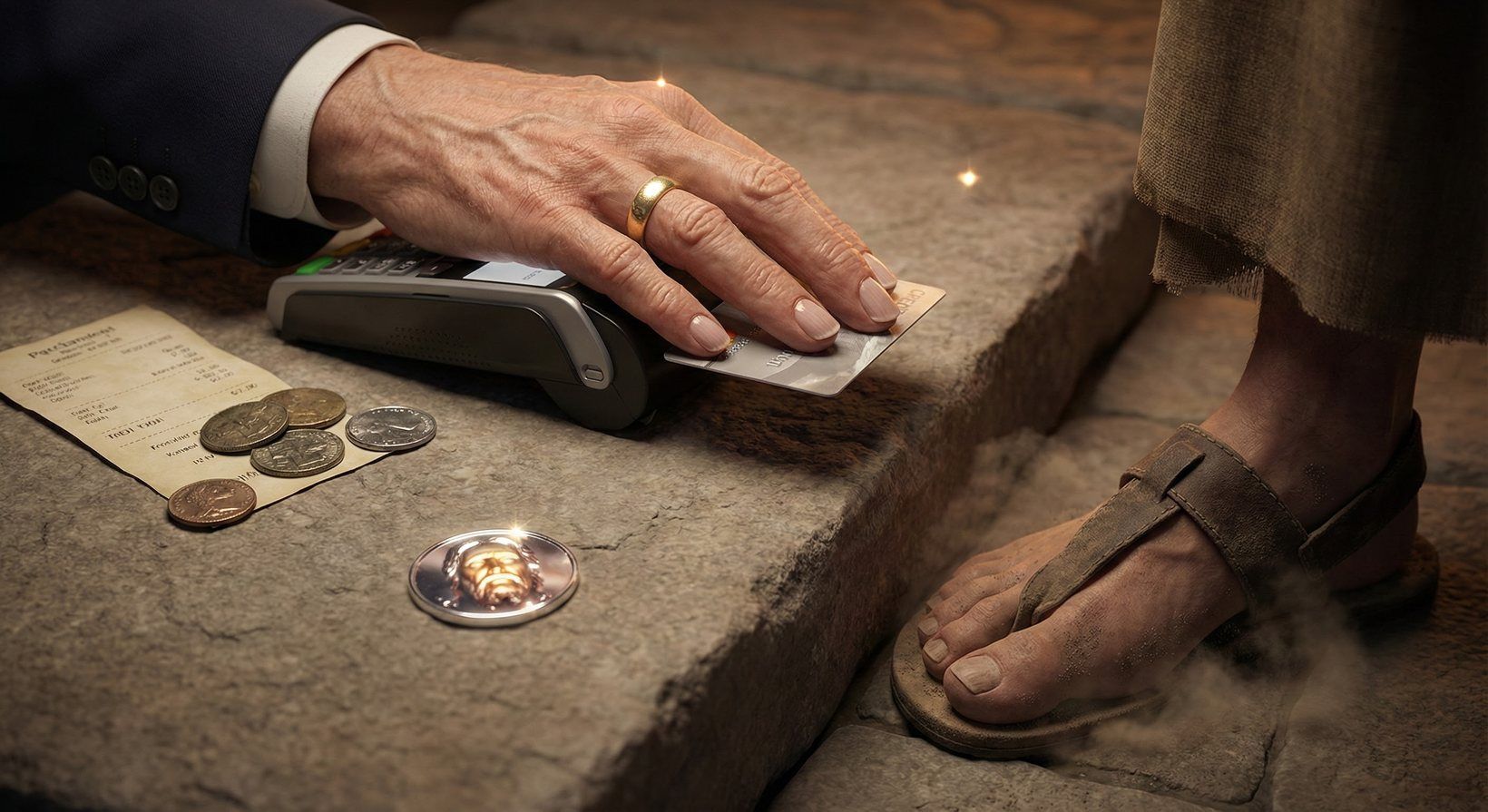
The Office has noticed something about persuasion that it did not expect to find while keeping ledgers.
An argument invites a reply. Tell a member that the institution hoards, and the member — reasonably — asks what hoarding means: whether reserves are prudence, whether the future has been accounted for, whether a large fund is not simply what a careful steward keeps. The argument opens a door, and an apologist walks through it. This is why a century of argument has moved so little. Argument is a form that answers itself.
A number does not open that door in the same way. When the Office discloses that one-tenth of one percent of the reserve, directed for a single year, comes to roughly thirteen thousand dollars for every meetinghouse in the United States — enough for a community kitchen open through the winter — there is no reply that is also a refutation. The figure is not a view about the institution. It is a fact about division. One may dislike it, but one cannot correct it.
This is the whole reason the Office builds instruments rather than only writing essays. A calculator does not argue; it computes, and hands the member the result to hold. A wheel does not argue; it turns, and stops on an outcome that happens to be, whichever way it lands, within reach of a fraction of what the institution already holds. The member enters the register of a game. By the time they notice they are not in a game — that every stop is a real thing that could be built, that there is no losing wedge — the fact has already landed, and it landed as arithmetic, not as accusation.
There is a discipline the Office keeps here, and it is worth stating plainly, because it is the difference between disclosure and propaganda. The numbers must be true, and their uncertainty must be named. A figure that overstates is worse than no figure at all, because a single corrected number discredits every honest one beside it. So the Office marks what is documented and what is estimated; it publishes a range where it cannot publish a point; it leaves standing, in its own confidence map, the one row it cannot support — whether a member who saw the arithmetic would change anything at all. The Office does not know. It suspects the honest answer is that most would not, and that this changes nothing about the duty to disclose.
Because the duty is not to persuade. It is to make the reserve thinkable — to move it out of the register of the unimaginable, where a hundred billion dollars is just a word, and into the register of a single ward, a single winter, a single kitchen, where the number becomes a decision someone declined to make. What the member does with a thinkable fact is the member’s own. The Office only insists that it be thinkable, and that it be true.
One click copies the complete, sourced text. Paste it into Claude, Kimi, ChatGPT, or any AI session and ask your questions there. Even our longest document fits in one paste.
Sources
- State of LDS Finances — 2026 (per-ward arithmetic; the ~$13K figure). See the Annual Report notes.
- The Revitalization Builder and Stewardship+ — the Office's instruments.