
The Genealogy Series has traced the reserve’s history — its founding trauma in 1837, its reformation in 1959. This dispatch is about its maturity: the secrecy regime as it actually operated inside the institution that built it, from the month the wall was poured to the year a federal appeals court declined, once again, to look over it. And it is about the wall’s depth: the graded secrecy the whistleblower describes is not a modern invention. Quinn’s hierarchy volumes document the same arrangement — presidents withholding the ledger from their own apostles — a hundred and thirty years deep.
Most of what follows is quoted from the 2019 Letter to an IRS Director, which this Office reproduces in full. The discipline matters: the document is public fact; the events it describes are the whistleblower’s account, much of it relayed to him from named officers of Ensign Peak Advisors, and this dispatch marks the difference at every step. Where the SEC and the Tenth Circuit later established overlapping facts by order and opinion, that is marked too.
The month the wall was poured
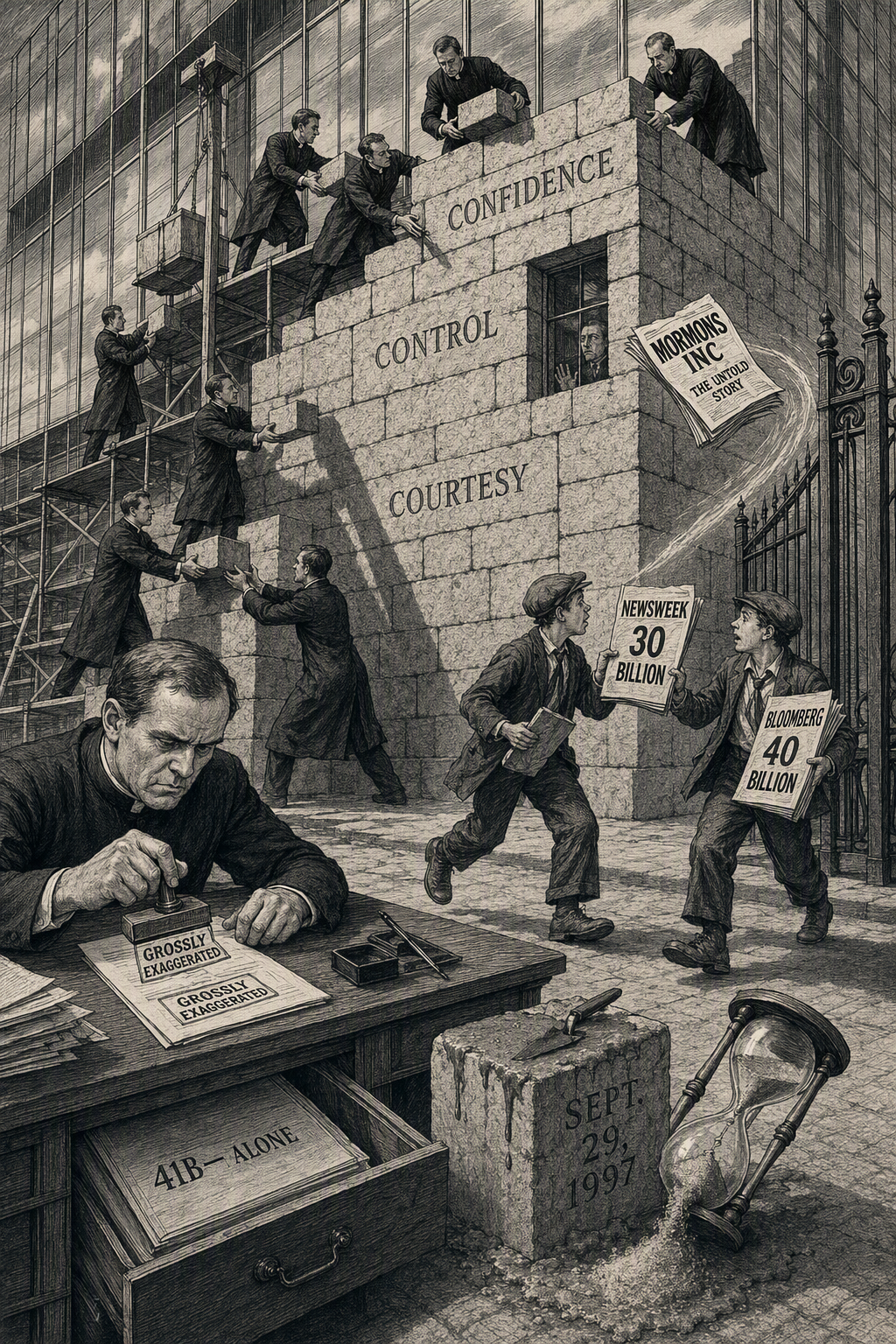
The reserve’s corporate form has a birthday, and the date is an admission. Ensign Peak Advisors was incorporated on September 29, 1997 — one month after Time magazine’s cover story “Mormons, Inc.” estimated the institution’s worth and caused a sensation. The Letter is flat about the sequence: the entity was “hastily incorporated,” one reactionary month after the story broke. The institution’s public response to Time was that the figures were “grossly exaggerated.” The Letter records what the figure actually was: years later, when Newsweek in 2011 put the whole enterprise at $30 billion, the reserve entity alone already held more than $41 billion; when Bloomberg’s careful 2012 methodology reached $40 billion, the entity stood at $47 billion — before counting land, chapels, temples, universities, or businesses. The denials were not errors. They were the wall’s first coat of paint.
The committee of those who know
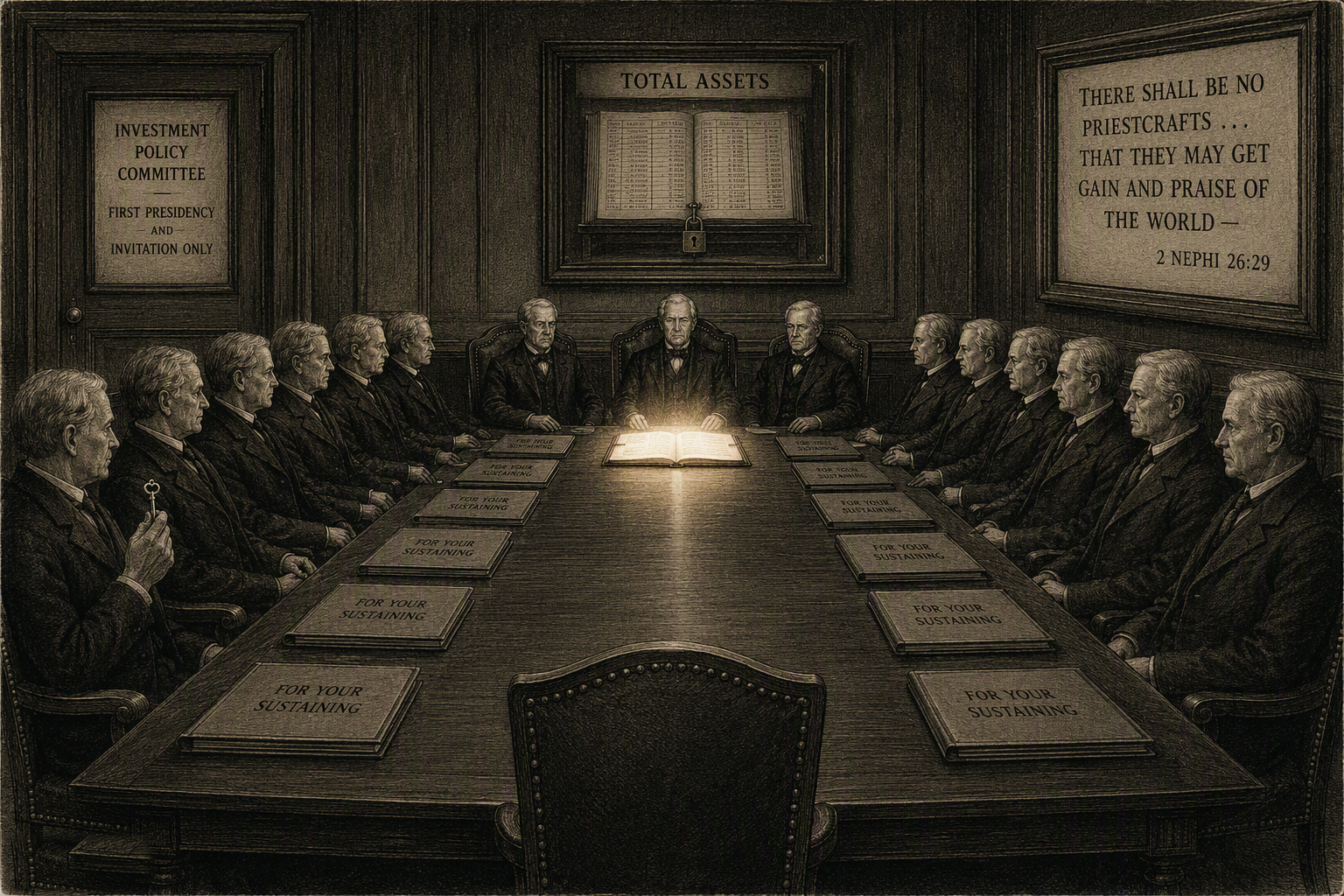
Start with the governance of knowing. The Letter states it in one sentence:
“Only the apostles in the First Presidency are in the Investment Policy Committee (IPC); not even the other apostles are allowed to know the total assets that the COP parks at EPA.”
The Investment Policy Committee is named in the footnotes: the three members of the First Presidency, the three members of the Presiding Bishopric, the fund’s managing director, “and a few others by invitation.” The Quorum of the Twelve Apostles — the institution’s second-highest governing body, the men presented to the membership as prophets, seers, and revelators — is not on it. A footnote adds that a handful of apostles have carried partial knowledge out of former seats: one served on the IPC while in the First Presidency and lost the seat; another came up through the Presiding Bishopric. Partial knowledge, carried by accident of prior assignment, is the exception that proves the rule.
The rule is that knowledge of the treasury is a function of the chair, not of the office. The apostolate does not know what the apostles, as apostles, might reasonably be expected to know. They are, on this question, laity.
The apostle who asked
The Letter’s longest footnote records the test case, and the Office quotes it at length because it is the document’s own telling:
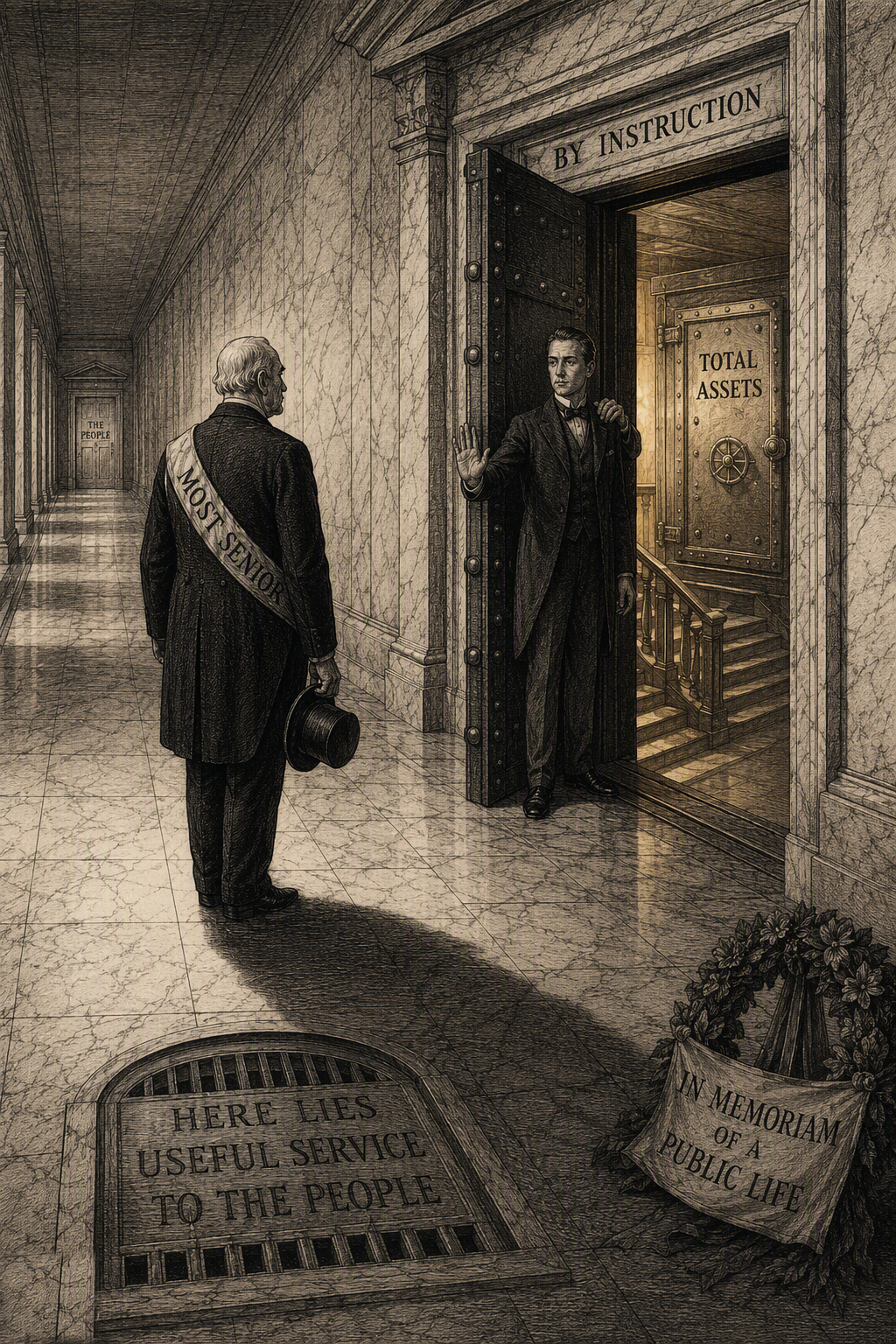
Boyd K. Packer — when he was next in line to succeed then-President of the COP, Thomas S. Monson — came to Mr. Clarke wanting to know how much Ensign Peak had amassed and the details of its structure. Mr. Clarke told Mr. Packer that he could not share such details. Mr. Packer said, “I think I should know. I’m the most senior Apostle and President of the Quorum of the Twelve Apostles, and I’m a breath away from being the next Prophet. I think I should be prepared.” Mr. Clarke reaffirmed that he had been instructed not to reveal that information to Mr. Packer, who went away perturbed and unsatisfied, as related to the whistleblower by Richard B. Willes, the Head of Fixed Income at EPA at the time. Mr. Packer died before he could join the First Presidency and know the value of EPA.
The Office’s annotations are three.
First, the sourcing is named: the account comes from the fund’s own Head of Fixed Income, relayed by the whistleblower under penalty of perjury. (The Letter spells the officer’s name both Willes and Willis; the Office reproduces, it does not reconcile.) This is attributed testimony, not adjudicated fact — and it is attributed testimony from inside the firm, filed with a federal agency, about a conversation between the fund’s managing director and the senior apostle of the church.
Second, the refusal came from instruction. The managing director did not decide that Packer should not know; he had been instructed — by whom, the Letter does not need to say, because the instruction can only have run downhill from the committee of those who know. The secrecy was not the manager’s preference. It was policy with a chain of command.
Third, the ending. Boyd K. Packer died in July 2015, still President of the Quorum of the Twelve, still outside the ring. Thomas S. Monson died in January 2018, inside it. The institution’s own ordering of succession — the most senior apostle becomes the next president — is also its ordering of knowledge: you learn the size of the treasury when, and only when, you inherit the chair that holds it. A man can spend sixty-five years in full-time church service, forty-five of them as an apostle, seven of them as the quorum’s president, and die without being told what the institution he governed was worth. The system worked as designed.
The ring is older than the reserve
The Packer refusal was not an incident. It was the latest recorded instance of a documented pattern, and the documentation is not the whistleblower’s — it is the hierarchy’s own historian’s. D. Michael Quinn’s Extensions of Power (1997) traces graded financial secrecy across a century and a half, in the institution’s own minutes and diaries. The Letter describes the ring from inside the firm; Quinn describes it from inside the quorums. The two accounts agree.
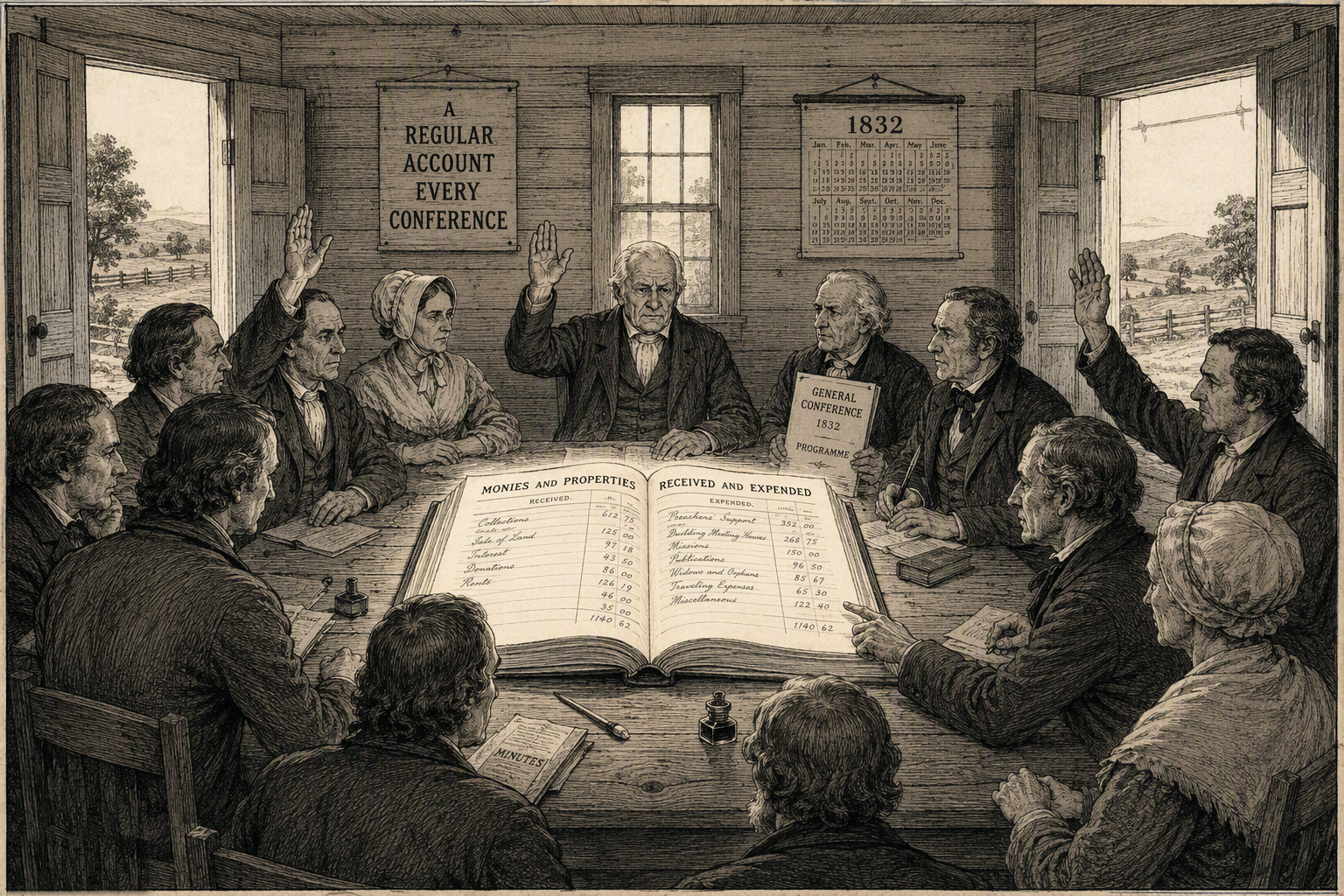
The accounts were not always secret. In 1832 a church conference voted that every general conference receive “a regular account of moneys and properties received and expended for the use and benefit of this church.” John Taylor proposed making the report annual — “an account of what was done with their means,” at least once a year.
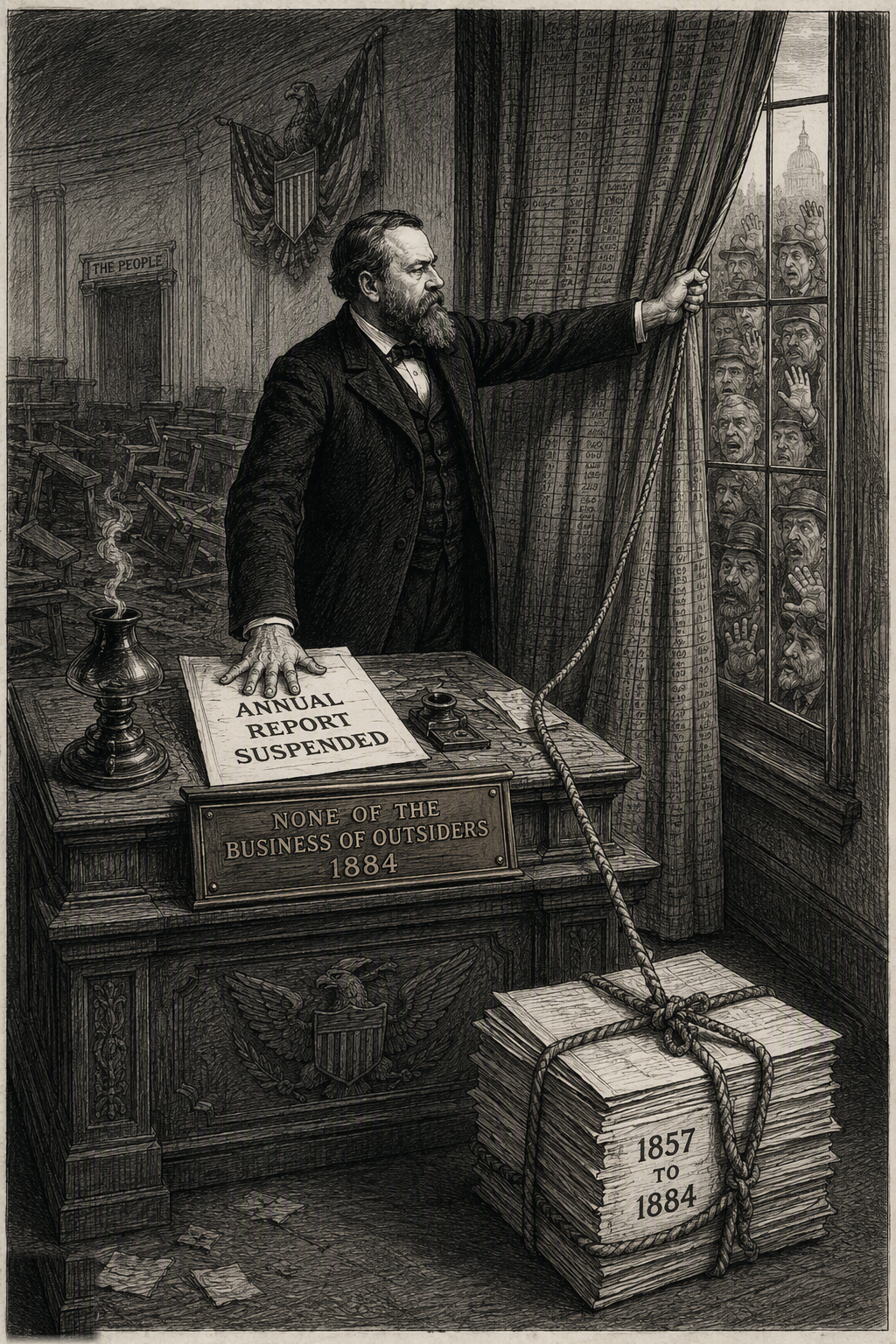
The apostles noticed the wall before the members did. In January 1898 the Twelve confronted the First Presidency in person over “the duties of the Apostles in Connection with the Presidency in the financial affairs of the Church” — every apostle present spoke plainly, and one accused the first counselor by name of causing the church’s great indebtedness and of “taking on himself too much of presidential authority.” Lorenzo Snow, succeeding to the presidency months later, opened his tenure with an admission: he wanted the apostles to know how everything stood, because “he himself had not been taken into the counsels of the First Presidency any more than the rest of us.” In 1899 senior apostle Franklin D. Richards argued for resuming the public accounting — to correct false reports and “bring the people to share in the responsibility of the Church’s business.” The argument did not prevail.
By the mid-twentieth century the pattern had a routine. Quinn records that President David O. McKay, from 1951 until his incapacity, “frequently made administrative decisions without consulting the Twelve and sometimes did not even inform them until after they had learned about the decisions from rank-and-file members.” Joseph Fielding Smith — president of the Quorum of the Twelve across those same two decades — knew only “bits and pieces” of the church’s finances, and occasionally learned of major financial decisions from newspaper reports. Apostle Henry D. Moyle complained that the Presidency withheld what the Twelve “should have known” — until he joined the Presidency, whereupon, in the words of the holding-company president, he “carried on [in] same way.”
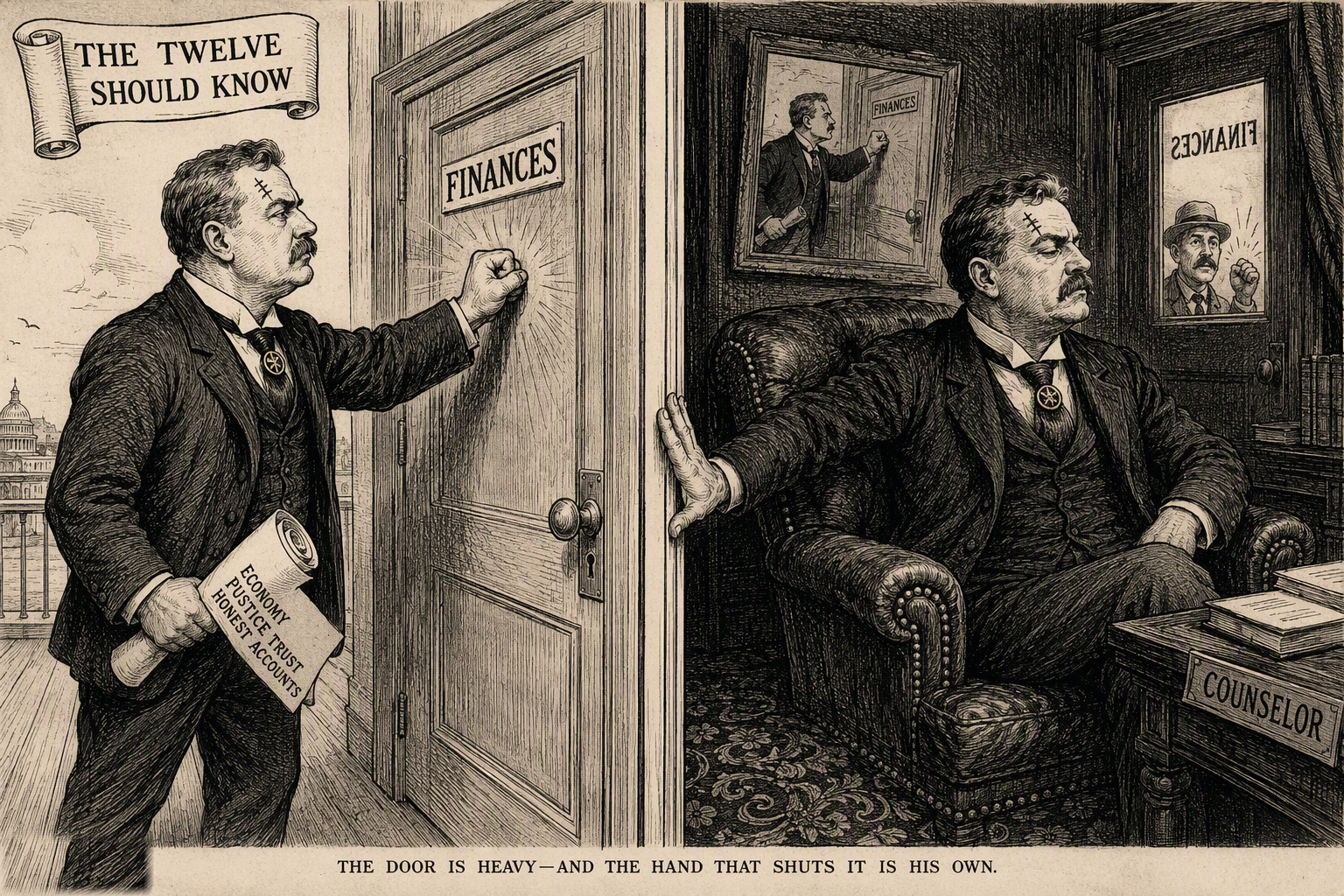
Read the Packer footnote again after that. A pattern documented by quorum minutes from 1884 to the 1990s — confrontation, admission, complaint, compliance — arrives at 2015 unchanged: the quorum’s president asks, is refused on instruction, and dies outside the ring. Quinn wrote before Ensign Peak’s name was public. The Letter wrote after. They describe the same wall from opposite sides, and the wall did not move.
The charges the ring gave itself
What was the reserve for? The Letter reproduces the institution’s own answer, from a 2013 New Staff Orientation slide: four charges — to fund prophetic initiatives, to supplement the operating budget, to backstop the pension plan and affiliated entities, and to post collateral. Then it reproduces the record against each charge, and the record is the indictment.
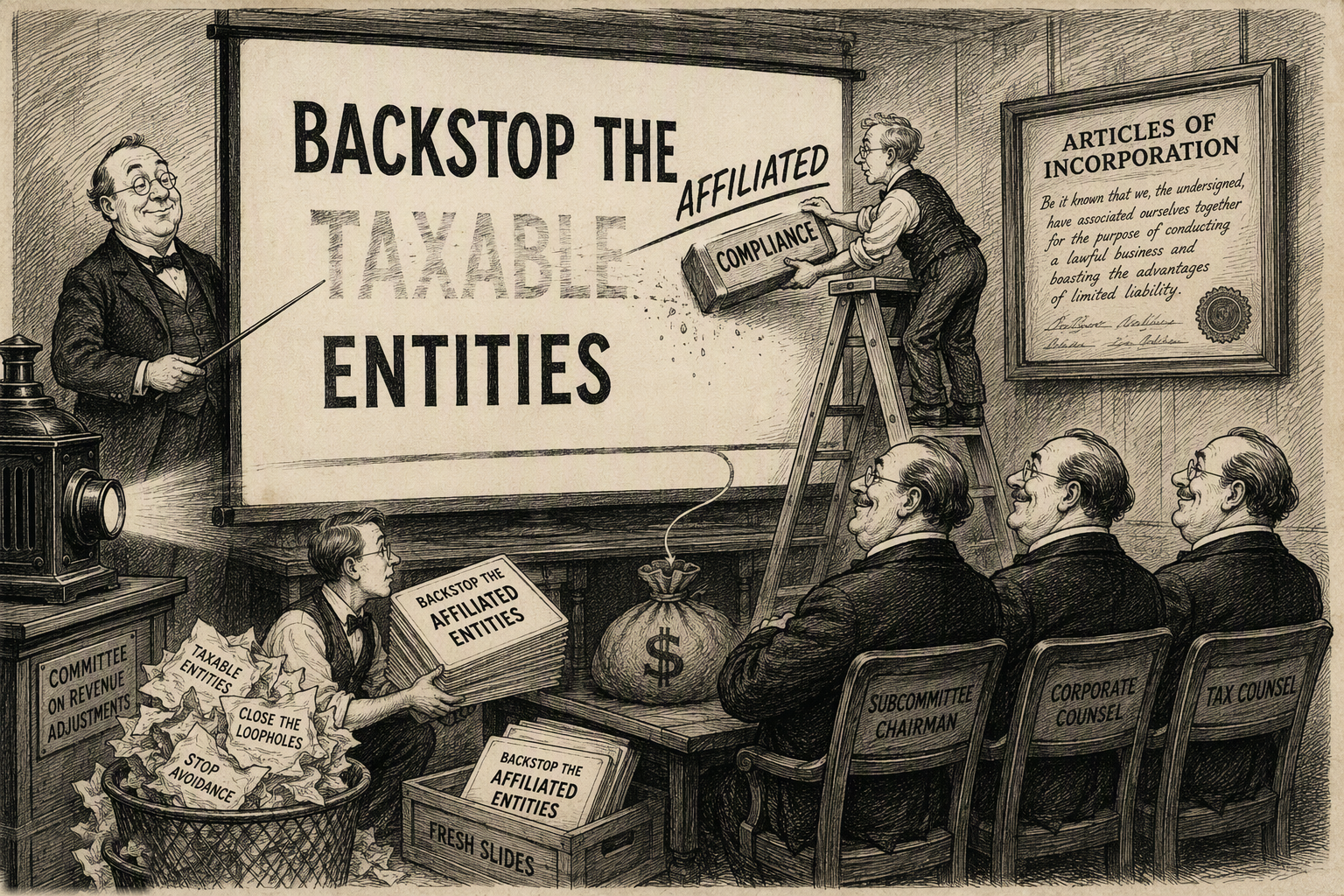
On prophetic initiatives: a companion slide from the same deck lists only three ever contemplated — the Conference Center, the temples, and City Creek — and shows $0 distributed to the first two. On the operating budget: “Money flows into the EPA Treasury account… No church department or function has ever made a capital call to EPA” — ever. On the backstop: never used; and the Letter preserves a small, perfect specimen of the ring’s editing of itself. An earlier version of the slide read “backstop the pension plan” and “backstop the taxable entities” — until a senior leader was told that backstopping a for-profit business contradicted the Articles of Incorporation, whereupon the slide was changed to say “affiliated entities.” The meaning was not brought into compliance. The word was.
And on purpose itself, the Letter records two answers from inside the ring, eleven words apart in spirit and a universe apart in candor. The managing director, asked point-blank in 2010 how the fund had never funded a prophetic initiative in thirteen years, answered that he did not know what the fund would be used for, and did not know whether the Lord would ever reveal it to the Prophet. A member of the Presiding Bishopric, in a small-group session with employees: “We don’t have any plans to use these funds at the moment. Waiting for God to tell us.” The reserve’s stated purpose is readiness for an instruction. The instruction has no date. This is not a treasury with a mission; it is a balance with a doctrine.
The two times money left
In twenty-two years, the Letter records exactly two outflows — both unplanned, both reactionary, and neither to anything charitable, religious, or educational.
The first was 2009. While the federal government was bailing out the institution’s preferred bank under TARP, the reserve was silently bailing out Beneficial Financial Group — the church-owned life insurance company — for $600 million, cut from the Treasury account that holds only never-invested tithing, “presumably to avoid the publicity and humiliation of a failed, church-owned, for-profit life insurance company.” The rescue worked; policyholders were kept whole — the Office has credited that elsewhere. The Letter’s point is narrower: the reserve’s single largest act of charity in two decades was to a corporation, in secret, against its own Articles.
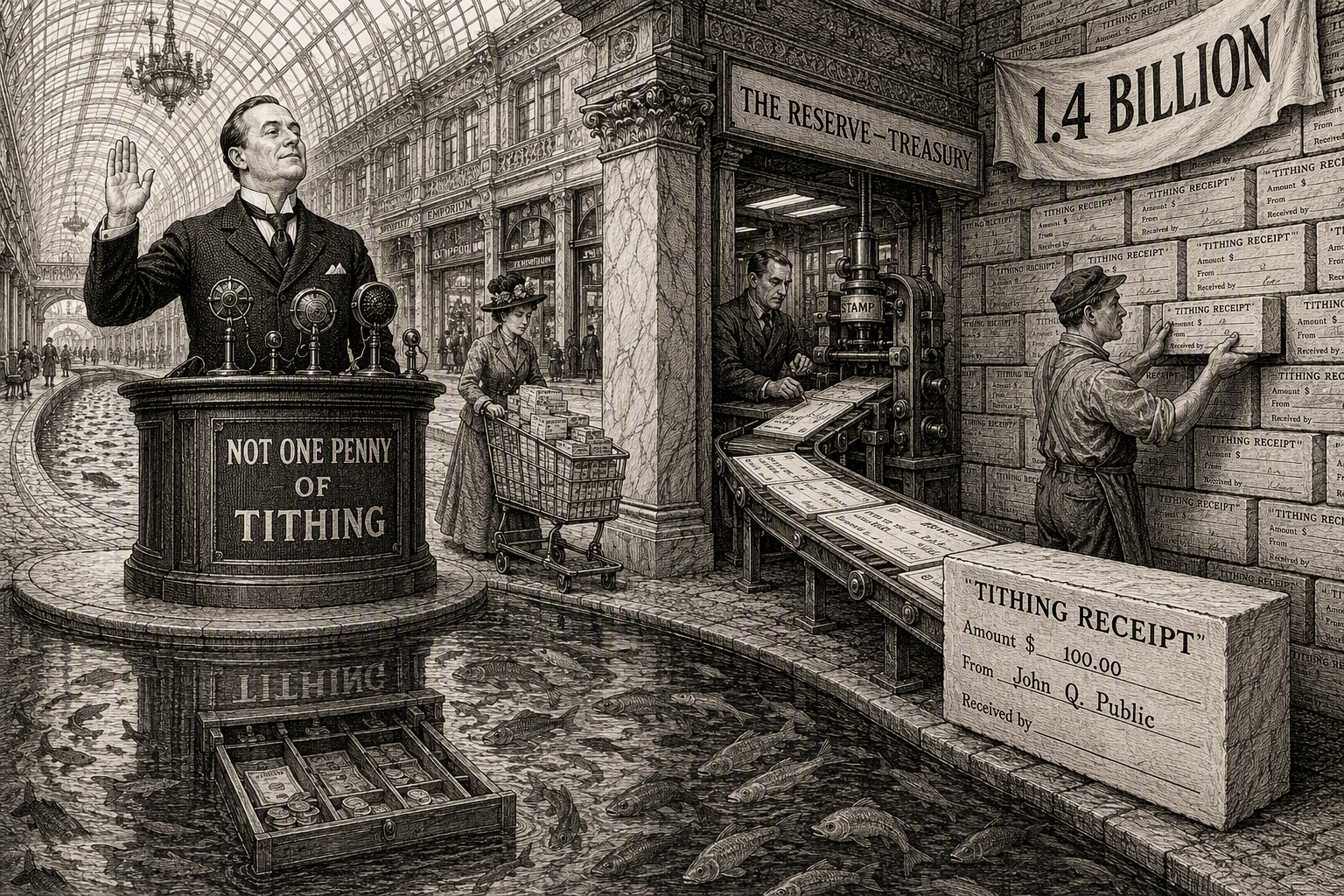
The second ran 2010 to 2014: $1.4 billion to shore up cost overruns on the City Creek mall — routed, per an internal slide quoted in later litigation, “so that people would not know that Ensign Peak was the source.” The institution’s magazine had already assured readers that no tithing funds would be used; its newspaper had attributed the financing to the real-estate arm’s other ventures. A member of the Corporation of the Presiding Bishopric then told the Salt Lake Tribune, reportedly: “not one penny of tithing goes to the church’s for-profit endeavors.” The Letter’s footnote is unmoved: the checks, drawn on the account containing only never-invested tithing, had already been written. There is also a third, smaller flow worth naming because it is the only one that recurs: the reserve posts collateral for church operations when asked — about $200 million to date. That is the complete works of the “supporting organization” in twenty-two years: a bailout, a mall, and a letter of credit.
The ring inside the firm
The Letter describes the same architecture replicated downward, inside Ensign Peak itself:
“EPA portfolio teams are siloed from each other in terms of asset data… only four employees are permitted to see EPA’s actual financial statements.”
The four are named: the managing director, the chief investment officer, the chief financial officer, and a senior accountant. The portfolio managers — the people trading the money — could not see the whole of what they traded. The counterparties were refused: banks and brokers subject to federal know-your-client rules repeatedly requested financial statements; the fund instead issued a one-page “Statement of Financial Condition,” and “EPA simply refuses to work with a counterparty that demands EPA’s financial statements.” And the anchoring was not neutral: the February 2018 statement, the Letter alleges, pointed business partners to a figure “above, but near, $5 billion” at a moment when the actual owned assets were $88.5 billion. Two years earlier the statement had said “$1 billion” against $75 billion. The misrepresentation, the Letter notes, “only grows with time.”
Even the auditors were partitioned. Because BYU receives federal funds, its endowment must be audited independently — and verifying BYU’s endowment once meant verifying the value of the fund’s shared portfolios, which would have shown the auditors the reserve. The Letter recounts the fix: a co-religionist audit director vouched for the figures without letting his auditors see them, for years; when the arrangement became untenable, the fund “painstakingly stripped out all affiliate interests” into separate accounts — so that, in the Letter’s phrase, the auditors “would audit a cup of water instead of an entire ocean.”
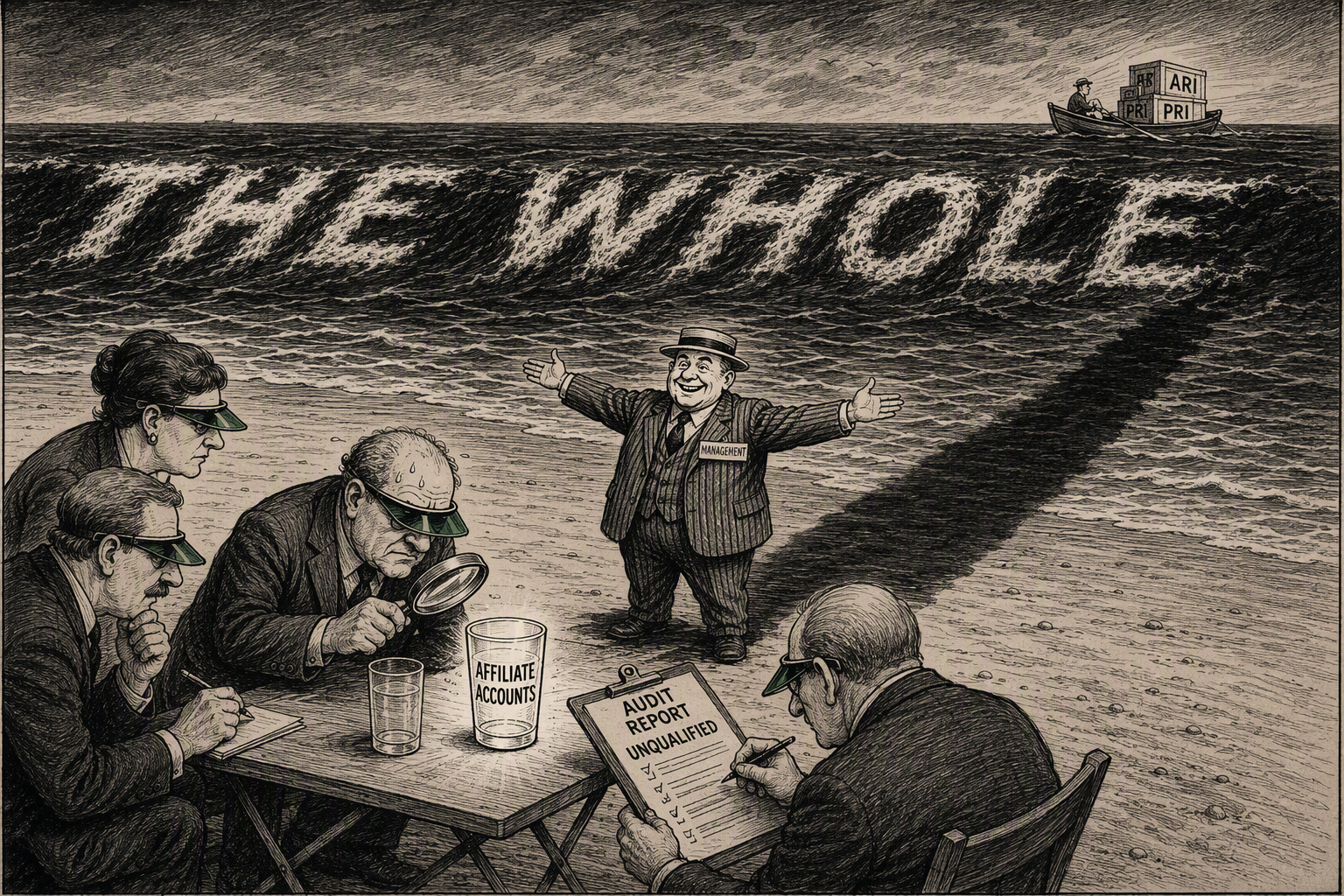
Inside the institution, then, the ring has at least four walls: the First Presidency and Presiding Bishopric know the total; the fund’s four officers see the statements; the portfolio teams see their slices; the apostles, the employees, the auditors, the banks, and the members see what each is handed. The Letter quotes the fund’s chief investment officer on what the architecture protects: “the biggest risk to Ensign Peak is the loss of its tax-exempt status” — not underperformance, not loss, exposure. The whistleblower’s gloss: a manager would be removed “only if they lost the firm its invisibility cloak.”
The reports the members used to get
There is a second genealogy, running beside the first: what the membership was allowed to see, and when it went dark. Quinn’s finance chapter dates every turn.
The church was born disclosing — the 1832 conference vote for a regular accounting, Brigham Young’s periodic reports (deficits included, with typical candor), John Taylor’s proposal for an annual statement. Then the 1884 sentence: “none of the business of outsiders.” In 1899 the argument for resumption failed. Through the early 1900s the conference received reports that disclosed nothing — 1907’s is preserved: the auditors find “every dollar” correctly entered and “economically and wisely” spent, and not one figure is named. Then, unexpectedly, the light: in 1915 the church released its first detailed public report, “to show how the tithing of the Church for the year 1914 has been disbursed” — and for forty-four years the annual reports showed total dollars expended in selected categories. The members of two generations knew, roughly, where the money went.
The forty-four years ended in 1959 — the same year this series’ previous dispatch opened the accounts: the deficit, the reformer, the building program that outran the tithing. N. Eldon Tanner’s reforms built the modern reserve, and the public reports stopped. The next detailed accounting the membership received of its church’s wealth arrived sixty years later, from a whistleblower, through the IRS. Born disclosing; darkened by a president’s sentence; restored for two generations; ended by the reform that built the vault; reopened by a former employee. That is the whole arc, and every date in it is documented.
The ring outside the firm
The public wall had three layers, and each is now a matter of record.
The first is statutory. United States tax law exempts churches and their “integrated auxiliaries” from the annual information returns every other charity files — income, expenses, disbursements, balance sheet, contributions, managers. The Letter walks through the provision: Congress wrote it for small congregations filing nothing because they had nothing to report; a reserve grown from $10 billion to $38 billion across its first decade, distributing nothing, “was not functioning as a supporting organization at all.” For scale: supporting organizations customarily run two to three times the supported body’s annual budget. This one ran past a hundred billion. The exemption built for the chapel became the vault’s first wall.
The second is now adjudicated. From 1997 to 2019 the reserve’s visible equity was not filed under the manager’s name at all, but fragmented across shell limited liability companies — Clifton Park, Green Valley, Riverhead, Tiverton, Elkfork, Flinton, Glen Harbor, Meadow Creek, Neuburgh, Tyers, among others — each filing a fragment, none naming the manager, so that no single filing showed the whole. In 2023 the Securities and Exchange Commission settled with the fund and the church over exactly this structure (proceeding 3-21285; the Office’s account is at Prior Filings). The SEC’s order converted the outer wall from allegation to established fact: the fragmentation was real, was found, and was for concealment.
The third is rhetorical, and it is the layer applied to the members directly. The institution’s Presiding Bishop, in a 2018 address on church finances: “Ultimately, all funds earned by the Church’s investments go back to supporting its mission.” The Letter’s arithmetic is unmoved: the reserve’s proceeds had gone, in twenty-two years, $0 to the mission, $600 million to a failing insurance company, $1.4 billion to a shopping mall. The same address revived a decades-old presidential quote — the businesses’ combined income is “relatively small” — that was defensible in 1985 and is not now; the Letter’s dry note is that “brief” and “perpetuity” are not synonyms. And an apostle’s 2016 statement that humanitarian aid averaged $40 million a year sits, in the Letter’s footnotes, beside the possibility that the apostle did not then know the reserve alone held $81 billion — because, per the same document, he was not allowed to. The carefully worded statement is the ring’s native idiom: true in the shape of the sentence, false in the shape of the world, and deniable in both. In 2016 the tithing-settlement form acquired a lawyer’s sentence of its own: the Church provides no goods or services in consideration of the contributions, “but only intangible religious benefits.” The wall, by then, was being maintained by the forms the members sign.
The ring in court
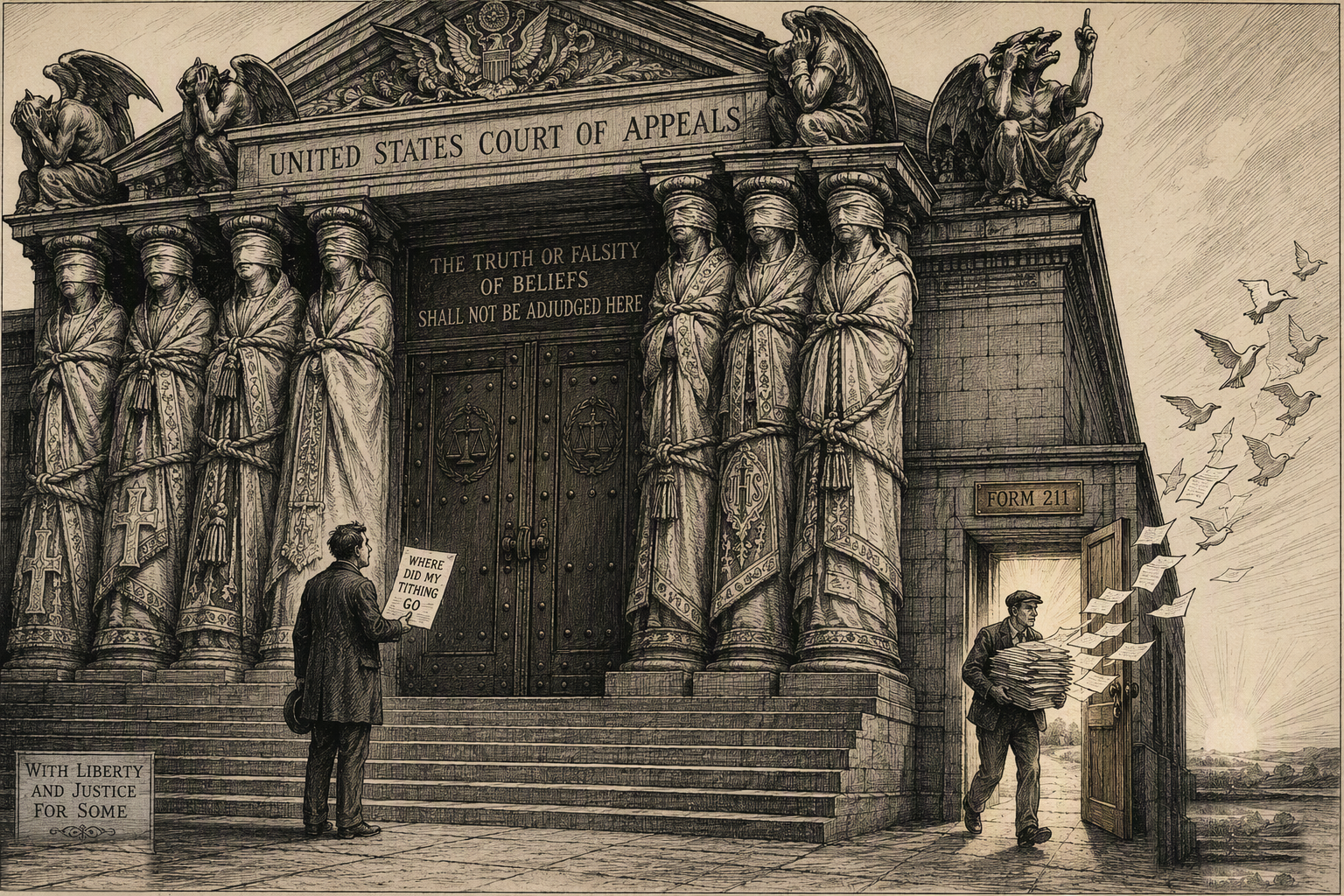
One member tested the wall in the place walls are supposed to fall. Gaddy v. Corporation of the President — decided by the U.S. Court of Appeals for the Tenth Circuit on August 26, 2025, and held in this project’s corpus — was a class action brought by members under civil RICO, on two theories: that the institution made fraudulent misrepresentations about its own history, and that it made fraudulent use of tithing payments. The district court dismissed both; the Tenth Circuit affirmed. The first theory, the court held, is barred by the church autonomy doctrine — the constitutional rule that courts may not adjudicate “the truth or falsity of religious beliefs.” The second failed on the pleadings, for want of sufficiently stated indictable acts.
The Office draws no comfort from the outcome and offers no critique of the doctrine. It records the geometry. A member who believes she was told falsely how her tithing would be used cannot make a federal court ask the question — not because the answer is known, but because the question is ruled out of bounds. The ring’s final wall is not built by the institution at all. It is the law’s own deference, and the institution lives behind it rent-free. The only forum that has ever extracted a fact about the reserve is the one the institution could not appeal: a former employee, a Form 211, and the public record.
What the ring is for
The Letter is a financial document, but its most valuable pages are anthropological — the ring at work on its own people.
There is the employee discipline: fund staff must be full-tithe payers and temple-recommend holders; before 2017, a manager or HR officer went desk to desk requiring employees to show the recommend; afterwards the checks ran electronically, and from 2019 a system let local clergy report the weekly attendance and worthiness of church employees to headquarters. The institution that hides its ledger from its apostles audits the devotion of its clerks. There is even an internal term for the desired condition of the employee and the member alike: church broke — broken in, as one breaks a horse, disposed to accept direction without question. The ward system itself is quietly denominated in the same currency: congregations divide and consolidate, the Letter notes, as a function of “tithing faithful per square mile.”
There is the candor of the inner ring at lunch — the food-court remark from the fund’s Director of Fixed Income: “Maybe the purpose of the funds was not to be spent at all, but to stand as a witness to the leadership of the church of the obedience of its members.” There is the remark the Letter attributes to reserve leadership viewing the fund as a “dowry” to be made worthy of the bridegroom — as if the bridegroom’s regard were priced in billions. And there is the scripture the ring half-remembers. The Letter closes one passage with the founder’s own teaching, from the History of the Church: “If you do not accuse each other, God will not accuse you… If you will throw a cloak of charity over my sins, I will over yours — for charity covereth a multitude of sins.” The Letter’s rejoinder is the one line in its seventy-four pages that reads like a prayer: how many sins would a charitable distribution of $124 billion cover?
And there is the trajectory, stated in the Letter’s own model: at prior growth rates, the reserve universe reaches $336 billion by 2029 — the Office’s own envelope is more conservative and is stated separately, but the direction is not in dispute. A reserve with no liability stream, no schedule of activities, and no plans for use does not need a reason to grow. It needs only to be left alone.
The Office’s note
The Genealogy Series does not usually editorialize, and this dispatch’s facts can carry their own weight. The Office adds one structural observation, because it is the reason this piece exists.
Secrecy inside the institution is not a perimeter; it is a gradient. The member answers to the bishop, the bishop to the stake, the stake to the area, the area to the quorum — and at every step the account of the member flows up while the account of the money stays level. The Twelve manage the laity without knowing the ledger. The First Presidency knows the ledger and answers to no congregation. The auditors see a cup of water; the banks see a page; the press saw denials; the courts see a doctrine they may not examine. The Letter’s deepest finding is not the number — this Office publishes larger ones — but the discovery that the priesthood is itself laity to the inner ring, managed on a need-to-know basis, with the need decided above. Operation VII names the class. This dispatch has shown you the door in the class’s wall, who holds the key, and the senior apostle who knocked and was sent away.
One further note, on evidence. This dispatch quotes two witnesses who never met: the whistleblower’s Letter, written inside the firm in 2019, and Quinn’s hierarchy volumes, written outside it two decades earlier. The first records the ring as it operated under Monson; the second records the same ring under Taylor, Snow, and McKay — the 1884 sentence, the 1898 confrontation, the president of the Twelve learning his church’s finances from the newspaper. When an attributed account and a documented history, composed independently, describe the same wall across a hundred and thirty years, the wall is not an allegation. It is the architecture.
The ring’s own Head of Fixed Income had the epitaph ready in 2011: the longer you wait to disclose, the harder it is to defend. The institution waited eight more years. The complaint, the SEC order, the Gaddy docket, and this site are what the wait purchased.
One click copies the complete, sourced text. Paste it into Claude, Kimi, ChatGPT, or any AI session and ask your questions there. Even our longest document fits in one paste.
Sources
- Lars Nielsen, Letter to an IRS Director (2019) — every quotation from the Letter is from the text reproduced in full on this site. The document's existence and contents are PUBLIC FACT; the events it recounts are ATTRIBUTED — the whistleblower's account, much of it relayed from named EPA officers. The Form 211 whistleblower submission is David Nielsen's; the Letter is Lars Nielsen's analysis filed with it.
- D. Michael Quinn, The Mormon Hierarchy: Extensions of Power (1997) — ch. 2 (the Twelve 'not privy' to finances: pp. 46–53, 59) and ch. 6 (the disclosure genealogy: pp. 212–14; the 1845 exemption: pp. 199–200). Full text in the project's corpus; page pins as printed.
- U.S. SEC administrative proceeding 3-21285 (2023) — the shell-entity settlement; PUBLIC FACT. See Prior Filings.
- Gaddy v. Corporation of the President, U.S. Court of Appeals, 10th Circuit, case 23-4110, decided 26 August 2025 — PUBLIC FACT; the decision is in the project's corpus.
- The companion structural accounts: The Priestly Class (The Operations, VII) and The Vault (III). Figures in Office working terms: Notes & Methodology.
- Third edition (2026-08-08): added the Quinn genealogy — the 1884 sentence, the 1898 confrontation, Snow's admission, McKay-era practice, and the disclosure arc 1832–2019. Second edition added the wall's founding, the four charges, the two distributions, the perception record, and the Gaddy decision. First edition 2026-08-07.