
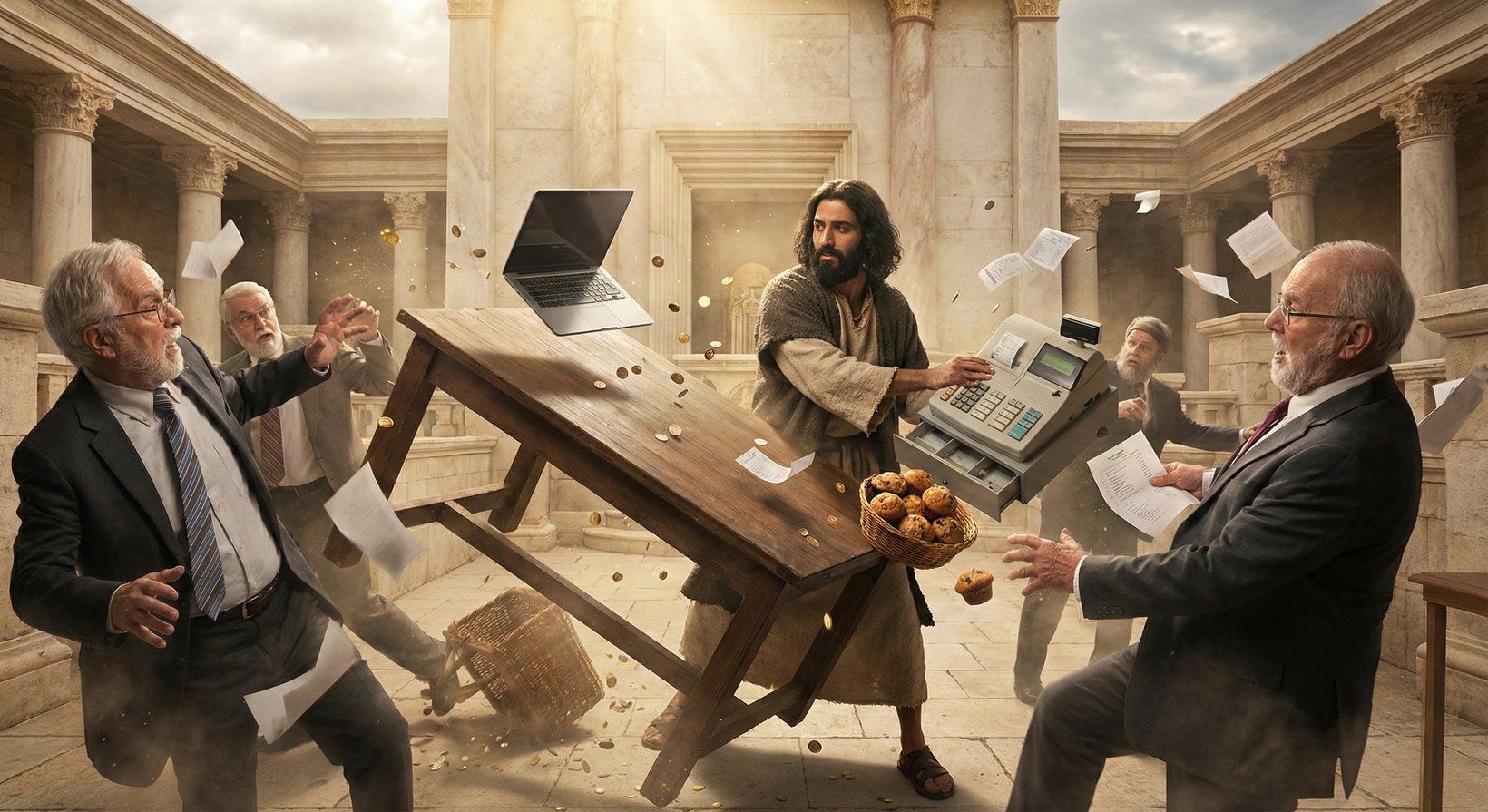
A note from the Office. From the project’s working papers, recovered from a conversation archive: it does in narrative what the Annual Report does in tables. No person is named, and no accusation made. Its one figure — a present value of $320 billion — is the author’s; the published estimate is lower and is stated as a range. Read it as a description of a mechanism, not as a statement of holdings.
At first, the goat is not a symbol.
It is a family’s offering. A portion of income set aside. A check written in quiet faith. A young couple choosing tithing over rent flexibility. A retired man sending what remains of his savings because he believes it belongs to God.
The goat lives in the ordinary world of use. It has a price. It is measurable. It could have been groceries, tuition, relief for a neighbor. It is, at this stage, still fully within the logic of exchange.
But then something happens.
It is named.
Not literally, but structurally. It is declared not merely money, but offering. Not merely transfer, but covenant. It is lifted out of equivalence and placed into meaning. What was once divisible and fungible becomes indivisible and sacred.
The goat has been consecrated.
I. The Early Pasture
In the beginning, the goat circulates close to where it was raised.
It feeds chapels, funds local care, sustains the visible life of the community. The one who gives can still see, dimly but concretely, where the offering moves. The shepherd and the herd are near each other.
Authority here is personal, or at least proximate. Decisions are made within sight of consequence. The one who cuts the goat does so in view of those who raised it.
The institution at this stage is not yet an institution in the full sense. It is still a network of obligations, relationships, and shared belief.
But even here, something accumulates.
Not just money — surplus.
Surplus is not a problem. It is prudence. It is preparation for famine, for expansion, for the unknown future. No one questions its existence. In fact, it feels like wisdom.
And so the first shift occurs, almost invisibly: the goat is no longer only consumed — it is stored.
II. The Storehouse
Storage requires structure.
Accounts must be kept. Flows must be tracked. Surplus must be preserved against decay, inflation, misallocation. What begins as stewardship becomes management.
At first, this deepens trust.
Those who oversee the storehouse are careful. They multiply what is given. The goats, now aggregated, begin to produce offspring — returns, interest, growth. The offering does not disappear; it expands.
This is interpreted as blessing.
And yet, structurally, a transformation has occurred: the goat no longer moves directly from giver to need — it moves into a system.
The system has its own requirements:
- continuity
- predictability
- insulation from volatility
These are not spiritual categories, but they become necessary conditions for preserving what has been entrusted.
The distance between the giver and the use widens.
Not dramatically. Not enough to provoke concern. But enough that visibility begins to fade.
III. The Treasury
By the time the accumulated goats reach a certain magnitude — by 2026, a present-value of $320 billion — they no longer behave like offerings.
They behave like a treasury.
A treasury does not think in terms of individual goats. It thinks in:
- portfolio allocation
- risk exposure
- time horizons measured in decades
At this scale, the original act of giving cannot meaningfully direct outcomes. No single goat, nor even many, can alter the system’s trajectory.
This is not because anyone has decided to ignore the giver.
It is because scale dissolves voice.
The contributors form what appears to be a unified body, but structurally they are diffuse. Each gives faithfully, but no one can monitor the whole. The cost of understanding exceeds the capacity of the individual.
And so the system becomes, by necessity, self-interpreting.
IV. The Priesthood of the System
Those who oversee the treasury are not different in intention from those who once tended the pasture.
But their position has changed.
They no longer manage goats. They manage flows, projections, constraints. Their decisions operate at a level where individual suffering or local need is not absent — but is abstract.
They do not see less.
They see differently.
Responsibility expands upward: from feeding the present, to preserving the future.
And in doing so, a subtle inversion occurs: the highest good becomes the continuity of the system itself.
Not because it is declared explicitly, but because every decision must now be justified in terms of long-term stability, protection of assets, avoidance of institutional risk.
The system cannot easily justify actions that significantly reduce its own capacity to endure.
And so it does not.
V. The Cutting
The goat is still brought forward.
Members still give. Faithfully. Quietly. With the same intention as before: to serve God, to sustain community, to relieve suffering.
The ritual remains intact.
But the meaning of the cut has shifted.
Before, the cut transferred the goat from the world of use into the world of the sacred — and then back into the community as care.
Now, the cut transfers the goat into the system.
The system receives it, absorbs it, and places it within a structure designed not primarily for immediate expenditure, but for preservation and multiplication.
The goat is not destroyed.
It is transformed into capital.
And capital does not die.
It circulates, grows, reinvests — across industries, sectors, geographies. It participates in the entire economy, without regard to whether that participation aligns with the original symbolic meaning of the offering.
This is not hypocrisy.
It is the logic of capital once it reaches sufficient scale.
VI. The Quieting of Voice
If a member asks: Where did the goat go?
There are answers.
Reports, statements, general accounts of stewardship. Enough to affirm that the system is functioning, that nothing has been lost, that the goats are safe.
But not enough to trace the path from sacrifice to outcome.
Not because of concealment, but because the path no longer exists in a linear form.
The goat has entered a network.
To follow it would require understanding the entire system. And the system is too large.
Exit is costly — socially, spiritually, relationally. Voice is diffuse — each individual too small to affect direction.
And so loyalty stabilizes the structure.
Not by force. By devotion.
VII. The Institution as Territory
Over time, the system begins to resemble something beyond a church.
It has:
- diversified assets across the global economy
- internal decision-making insulated from external pressure
- time horizons extending beyond generations
- the ability to act strategically, not reactively
It no longer depends on immediate contributions for survival.
It governs itself.
Not politically — but structurally.
It becomes a kind of territory: not defined by land, but by capital and continuity.
VIII. The Final Transformation
Nothing essential appears to have changed.
The language is the same. The rituals are the same. The goat is still brought forward.
But the function has shifted.
What began as sacrifice for God and community has become, without declaration, sacrifice for the perpetuation of the institution that carries God’s name.
The distinction is subtle.
And difficult to see from within.
Because the institution still does good. Still builds, teaches, organizes, stabilizes. The system is not empty. It is effective.
But its center of gravity has moved. From presence to administration; from care to management; from sacrifice to accumulation.
IX. The Persistence of Sincerity
The members remain sincere.
This is what stabilizes everything.
They do not give because they are deceived.
They give because they believe.
And because they believe, the system does not need to coerce, or even persuade aggressively. It only needs to continue existing, reliably, authoritatively, indefinitely.
The goat continues to come.
X. The Unresolved Question
What would it mean for the system to reverse?
To move from treasury back to pasture?
It would require not just redistribution, but redefinition: of risk, of responsibility, of what it means to preserve something sacred.
Because the system now protects not only wealth, but its own continuity as a vessel of meaning.
To reduce itself would feel, internally, like endangerment.
And so the system remains.
Stable. Expanding. Rational.
And still, every week, the goat is brought forward.
One click copies the complete, sourced text. Paste it into Claude, Kimi, ChatGPT, or any AI session and ask your questions there. Even our longest document fits in one paste.
Sources
- Recovered from the project's conversation archive, 2026. Lightly edited for line-breaks and headings; no wording changed.
- The figure it names is the author's. The Office's own envelope is roughly $200 billion for Ensign Peak alone and roughly $300 billion for total affiliated wealth, both marked as estimates. See Notes & Methodology.
- The mechanism this allegory describes is set out in the Office's own register at Why the Reserve Cannot Shrink.